

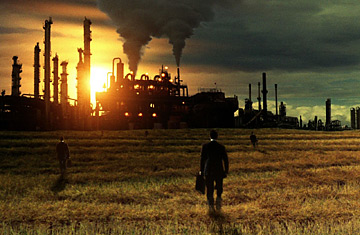
Food, Inc. shows how America's edibles changed as the nation journeyed from agrarian to industrialized.
Correction Appended: June 18, 2009
There's a corner of my bookshelf that I think of as the region of Reader Guilt crossed with Digestive Despair. Michael Pollan's 2006 best seller, The Omnivore's Dilemma, resides there, its elegant shoulder pressed up against that of greasier, grittier but also very fine Fast Food Nation (2001), another best seller, by Eric Schlosser.
While first enraptured by these books, I eagerly regurgitated their messages about what's wrong with the U.S. food system (essentially, everything) to everyone around me, throwing out data about the horrors of our centralized feedlots, where livestock is fattened on an unnatural diet based on corn, or the horrors of our supermarkets, where we are offered the same grotesque opportunity, since corn and its by-products are found in everything from Coke to ketchup. And yet I admit to abandoning Pollan on page 182 and Schlosser not long after his chapter "Why the Fries Taste Good," which should have been called "Let Me Rid You of That Fry Craving for Good." Why? I was overwhelmed. Every meal I had to shop for, cook and serve my family between chapters loomed like a toxin-filled minefield.
Now I have the bracing tonic of Robert Kenner's passionate, witty documentary Food, Inc. to reinspire me. As important as any of Michael Moore's polemics but free of his obnoxious techniques, the film presents the wealth of Pollan's and Schlosser's reporting in a succinct and compelling format. Starting with a tour of our supermarket shelves, it traces our evolution from an agrarian nation to one of monoculture--approximately 30% of U.S. cropland is planted with corn, which is easy to grow but, since it's rarely served in healthful ways, hard to stomach. We meet the meat, most of it miserable, corn-fed, dosed with antibiotics and on its way to centralized slaughterhouses and processing plants. Kenner shows us farmers in peril, powerful corporations in charge, scientists cooking up genetically modified foods and the toll the system takes on our health and sometimes even our lives. But in giving us a taste of the rising rebellion against this centralized food system, the film offers the crucial kernel of encouragement that the whole mess might not be insurmountable.
Meeting the Meat
Food, Inc. features interviews with Pollan and co-producer Schlosser, as well as one of Omnivore's most charismatic characters, Joel Salatin, a Virginia farmer. Salatin feeds his livestock grass and waxes eloquent while reclining in a patch of his animals' dinner entrée, looking nearly ready for Playgirl's Multiple-Organic Issue. But the film is not just a distilled version of Pollan and Schlosser; it produces fresh faces to neatly illustrate some of the denser but crucial points of their reporting. (The 2006 feature film Fast Food Nation, director Richard Linklater's adaptation of Schlosser's book, diminished its own sense of urgency with a fictionalized narrative.)
Among the new characters Kenner introduces us to are an impoverished immigrant family of four--the dad is diabetic--struggling with the baffling reality that fast-food hamburgers are cheaper than a head of broccoli. And a brave chicken farmer lets Kenner's cameras see her operation, only to subsequently lose her contract with Perdue.