

(3 of 3)
When I add a new friend on Facebook, for instance, a few moments later, he appears as a contact on my Pre. If he is already there, WebOS is smart enough to just add anything that is missing — his birthday, say — to the existing contact.
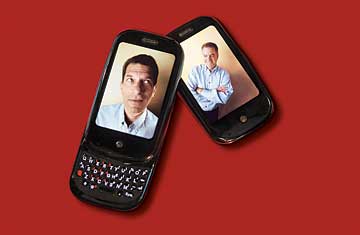
Mashing up all those feeds in one place could be confusing. But the Pre handles it intelligently via something it calls Universal Search. The Pre is a slide phone — a touchscreen on its face gives way to a keyboard below. Simply start typing, and WebOS pulls up a pane that searches your contacts and also gives you the option to search via Google, Wikipedia or Twitter. You can type, "How fast does a zebra run," hit a Google button and get the answer. Pretty sweet.
The bigger idea here is that WebOS is designed to simulate the Web itself. In fact, anyone who can build a website can write applications for this platform, which is why Rubinstein expects a flood of Pre apps shortly. "The user environment in WebOS is a website," Rubinstein says. That's a powerful hook, especially if you believe that the Web will continue to grow relentlessly.
Finally, the user interface is especially cool and does something I've never before seen on a smart phone: it can run a dozen applications simultaneously. Each app is represented by a virtual card after it launches; switching between programs is as easy as leafing through the cards. To close an app, you simply flick it away.
The Pre does have issues. I've used two for the past few weeks and run into a couple of early glitches. One was an operating-system bug that caused my first Pre to crash. Fixed, says the company. The other was a hardware issue that drained my battery in five hours. Palm says that's an anomaly but is investigating. The other things I disliked are pretty minor and easily corrected. Cut and paste is very limited and clumsy to use; there are only a dozen applications available at launch, and your IT guys can't remotely wipe it if it's lost. Still, I complained bitterly about the same things with the first iPhone in 2007, and now I embrace it with the zeal of a convert. Could that happen with Pre? Maybe.
Apple is taking a "Pre who?" approach so far. But it's doubtless ticked off that the Pre cheekily syncs with Apple's proprietary iTunes software. (Rubinstein claims he's doing Apple a favor by making it easier for Pre owners to buy music from the iTunes store.) Needless to say, Apple is hardly standing still. New iPhones are rumored — perhaps they'll be unveiled at an Apple developers' conference on June 8 — and its operating system will get an upgrade.
Still, Rubinstein has managed to keep Palm in the race. The Pre ought to find new converts, but it is Palm's WebOS that's the key to success. Rubinstein told me that Palm is working on an array of mobile Internet devices, all powered by WebOS, which he argues — persuasively — is built to last a decade or more.
While I'm not giving up my iPhone yet, the Pre is certainly the first sexy alternative. Palm stock has surged, from $1.42 a share in December to about $13 last week. And the more I hear sources at Apple dissing the WebOS as not being all that revolutionary, the more I suspect this could turn into a marathon after all.