

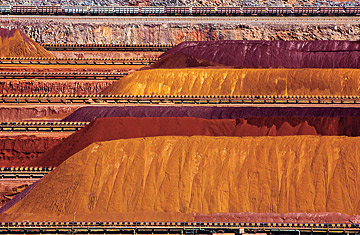
A Rio Tinto iron-ore mine; China plans to double its stake in the company to 18%.
(2 of 2)
The Chinese are not likely to be deterred, because the opportunity to buy energy and minerals this inexpensively may be historic. That's why the China Development Bank and China Petroleum & Oil Corp. last month invested $10 billion in Petrobras, Brazil's state-owned oil company and the prime operator of one of the most promising new offshore fields in the world. The deal gives Petrobras capital to further develop the field. In return, China will get 100,000 bbl. to 160,000 bbl. a day for more than 20 years. And just before the Brazilian deal, Beijing agreed to lend $15 billion to cash-strapped Rosneft, Russia's largest oil company, and an additional $10 billion to Transneft, Russia's biggest pipeline company. The loans will be paid off not in cash but in crude--300,000 bbl. a day from the huge east Siberian oil fields. That's about 4% of China's current demand for crude oil. Over the 20-year life of the deal, Beijing will effectively be paying about $20 per bbl. With oil expected to return to $70 or $80 per bbl., it could be the steal of the new century.
There is a lot more oil and gas where that came from, if Beijing can bring itself to depend on Moscow as a supplier. The two former communist powers have never trusted each other, but new capitalist economics trumps old socialist enmity. Russia needs money, and China has $1 trillion sitting in corporate coffers.
There's no question that it's a buyer's market for raw materials and that many resource companies are struggling to find willing partners and financiers. China's Rosneft injection will allow the Russian company to pay off $8.5 billion in debt-- 60% of it owed to foreign banks--that matures this year. Beijing looks like the last, best hope of miners and drillers.
Even so, not every shareholder is thrilled at the prospect of selling to the Chinese. Chinalco is a huge consumer of iron ore, and mining companies fear that the investment in Rio Tinto could give China more influence over the price. During the boom years, when Chinese companies' appetite for virtually every metal was voracious, they got stuck with stiff price increases. The deal could give Chinalco, which already owns 9.3% of Rio, better access to the company's choicest deposits of copper, iron ore and bauxite. The secretary-general of China's Iron and Steel Association, Shan Shanghua, has already hinted that Chinese buyers could have some additional clout. This rankles some of Rio's major shareholders. "It's up to Rio to convince us that this does not transfer key pricing power over a key commodity to a big customer," says a large institutional shareholder. Chinalco has tried to allay such fears, and Chinalco president Xiong Weiping says Rio's corporate strategies and management practices would remain unchanged.
Considering how far mineral prices have fallen, some analysts believe Chinalco might actually be paying a premium for Rio Tinto assets. But BOC International's Xu says, "The price is much, much lower for the assets--particularly iron ore and copper--than it would have been just six months ago. This seems like a pretty good deal." And as long as commodity prices are depressed, Chinese companies will be Going Out, cash in hand, ready to buy.