

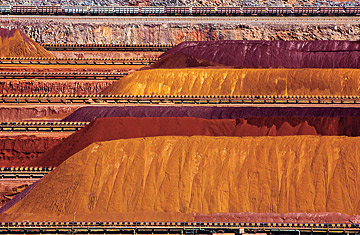
A Rio Tinto iron-ore mine; China plans to double its stake in the company to 18%.
A few years ago, the Chinese called it their Going Out strategy. State-owned companies in key industries were encouraged by the government to plant the flag of Chinese capitalism around the world by purchasing stakes in foreign companies. China was flush with cash and full of optimism--naive optimism, it turned out. Beijing's fledgling sovereign wealth fund China Investment Corp. poured $3 billion into New York City--based private-equity firm Blackstone in return for a 10% stake in the company--just before the bottom fell out of U.S. debt and equity markets. That deal was followed by a $5 billion purchase of a 9.9% stake in Morgan Stanley, whose share price has since fallen by more than half.
These were expensive lessons, but Beijing has decided that Going Out is still a better economic strategy than staying home. Despite China's slowing economy, officials see the global recession as a prime opportunity to cheaply acquire strategically important raw materials such as iron ore, copper, oil and gas--commodities China will need in vast quantities in the long run. In the past two months, Chinese companies have sought to buy assets abroad at an unprecedented pace. Aluminum Corp. of China (Chinalco) has announced plans to invest $19.5 billion in Rio Tinto, one of the world's largest mining companies. If completed, the deal would be the biggest foreign purchase any Chinese company has ever made. In late February, Hunan Valin Iron & Steel Group of China purchased a $771 million stake in the Australian iron-ore exporter Fortescue Metals Group. And China Minmetals, another state-owned firm, offered to pay $1.2 billion in cash for Australia-based Oz Minerals, the world's second largest zinc miner. "These [Chinese] companies know this slump, while deep, will not last forever," says Xu Minle, a Shanghai-based analyst at BOC International. "China is now making strategic investments overseas at a comparatively lower cost."
China's huge appetite is making some foreign governments nervous. Australia blocked the Minmetals deal with Oz, citing national security, forcing the Chinese firm to revise the offer to exclude a valuable gold and copper mine. And Libya exercised its option to buy Venerex Energy, a producer based in Calgary, Canada, whose biggest asset is an oil and gas field 100 miles (160 km) southwest of Tripoli. That thwarted a $390 million bid that China National Petroleum Corp. had made to acquire Venerex. Beijing hasn't done itself any favors either. It blocked--on antitrust grounds that analysts considered flimsy--a bid by Coca-Cola to buy a large, privately owned fruit-juice producer in China. "It gives [foreign] governments ammunition to use against Chinese acquisitions that wasn't available before," acknowledges a Hong Kong--based investment banker who is working on one of the resource deals.