

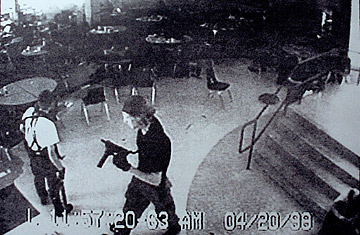
Columbine high school shooters Eric Harris, left, and Dylan Klebold appear on a surveillance tape in the cafeteria at Columbine High School April 20, 1999 in Littleton, Colorado.
They weren't gay. They weren't part of the Trench Coat Mafia (although there was a real Trench Coat Mafia). They weren't nerds or outcasts or goths, and they didn't target jocks or black people or anybody in particular. They did not go bowling for Columbine. They skipped class that morning instead.
Dave Cullen is a journalist who has spent the past 10 years in Colorado trying to figure out exactly what happened at Columbine High School on April 20, 1999, and why, and what the consequences were. He has read the killers' diaries, watched the surveillance tapes and interviewed many of the survivors. The result is his comprehensively nightmarish book Columbine (Twelve; 417 pages), published a few weeks shy of that grim 10th anniversary. Cullen's task is difficult not only because the events in question are almost literally unspeakable but also because even as he tells the story of a massacre that took the lives of 15 people, including the killers, he has to untell the stories that have already been told. (See pictures of crime in Middle America.)
Should this story be told at all? There's an element of sick, voyeuristic fascination to it--we don't need an exercise in disaster porn. But Columbine is a necessary book. Narrating an event is a way to tame it, to give it a meaning, and the Columbine massacre is an aggressively, catastrophically meaningless event, a rip in the smooth fabric of an otherwise comprehensible world. It's a vacuum that urgently demands to be filled.
The question is, Who gets to fill it? As soon as word of the atrocity began leaking out of the building--and it was on local TV 28 minutes after the first shot was fired--ownership of the story of Eric Harris and Dylan Klebold was being fiercely contested. Were they natural-born killers? Or were they victims themselves--of bullying, of bad parenting, of mental illness? Were they sent by the devil, as some local Evangelical preachers argued? The killers had a version of their story too, which they told in the journals and videos they left behind. They believed they were two living gods trapped in a world of zombies. (See TIME's 1999 cover story about Columbine.)
But the first lesson of Columbine is that "they" were not they. To understand Harris and Klebold, you have to learn to tell them apart. Harris was the extrovert: "He smoked, he drank, he dated. He got invited to parties. He got high," Cullen writes. An Army brat, shuttled from school to school, he had picked up the trick of being charming, but he also had a temper that flared when he didn't get his way. Klebold was physically more imposing--at 6 ft. 3 in., he was 6 in. taller--but he was less sure of himself.
Klebold suffered severely from what appears to have been undiagnosed depression. Harris had an undiagnosed ailment too, but it doesn't sound as though it caused him a lot of suffering. The consensus among psychiatrists is that he was a psychopath.
Psychopaths are neurologically different from healthy people. They're arrogant and obsessed with power and control, and they're cognitively almost incapable of remorse or empathy. Harris had a website where he repeatedly, repetitively rehearsed his grievances: "All I want to do is kill and injure as many of you pricks as I can!" (Among his pet peeves: people who pronounce espresso "expresso.") The journal he kept was called "The Book of God."