

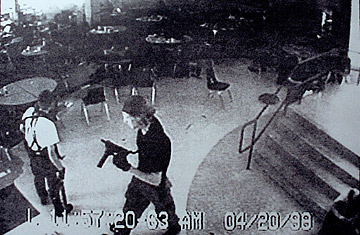
Columbine high school shooters Eric Harris, left, and Dylan Klebold appear on a surveillance tape in the cafeteria at Columbine High School April 20, 1999 in Littleton, Colorado.
(2 of 2)
Klebold called his journal, more poetically, "Existences: A Virtual Book." It alternates between odes to his lonely misery and pages full of winged hearts, symbols of his love for a girl Cullen calls "Harriet," to whom Klebold apparently never spoke. Whereas Harris dreamed of homicide, Klebold dreamed about suicide: "Thinking of suicide gives me hope that i'll be in my place wherever i go after this life--that ill finally not be at war w. myself, the world, the universe." Klebold was the follower, not the planner. Under Harris' careful direction, he learned to turn his inner pain inside out, into an insane desire to punish others. By the spring of 1999, he and Harris were both calling themselves gods. The rest of us were zombies, losers, robots, trapped in our inferior little lives by our inferior little minds. They were ready to kill. (Read "The Columbine Tapes.")
The actual events of April 20, 1999, are exactly as appalling as you'd expect, and Cullen doesn't spare us a second of them. To assemble a definitive timeline of the attack, Cullen has had to resolve hundreds of wildly divergent eyewitness accounts. This was, as he puts it, "the first major hostage standoff of the cell phone age," so as the nightmare unfolded, students were calling local news stations, which then fed their panicked stories back into classrooms via TVs in real time, creating a feedback loop that distorted their experience of the event even as it was happening. Maybe the most surprising thing to come out of Cullen's version is how quickly it all happened. What felt like an all-day ordeal lasted only 49 minutes before the shooters ended their lives. All the murders happened in the first 16. (See the top 10 non-fiction books of 2008.)
Americans took some lessons from Columbine, though not always the right ones. Colorado tightened restrictions on gun sales at gun shows ... but national legislation died in Congress. An epidemic of profiling swept U.S. high schools, but it was based largely on the erroneous idea that the killers were bullied outcasts. Armed-standoff tactics changed too. SWAT teams are now more likely to rush into a building and take down shooters immediately rather than establishing a perimeter and waiting for more information. That strategy may have saved lives at Virginia Tech, where in 2007, Cho Seung-Hui killed 32. (See pictures of the Virginia Tech shooting.)
What can we learn from Columbine, which is now the most convincing, authoritative narrative we have of the massacre? If it fills in the meaning of that senseless atrocity, what is it? Harris' story doesn't help us any. It's familiar and unilluminating: he was wired to kill. If there is a lesson here, it lies in Klebold's story, which is the more disturbing because he was, at heart, like us. He was capable of love and sympathy, and he discarded them. Some killers are natural born. Klebold was made.