

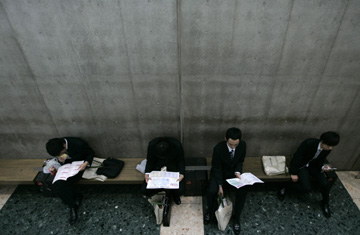
JOB SEARCH: Men look for work at a Tokyo job fair. Japanese firms have cut recruitment
(2 of 2)
Government suasion is particularly strong in China, where the global economic crisis has led to the closure of 7.5% of the country's small and mid-size companies since the end of 2008. In February, the central government's powerful State Council ordered companies throughout the country to notify local government-backed labor unions if they planned to cut either 10% of staff or more than 20 employees. In Beijing, state-owned enterprises have been ordered not to lay off any of their employees this year. The government is also looking to make positive examples of private businesses that keep on staff. That's why Liu Jingyu, a local entrepreneur in a suburban district of Beijing called Daxing, was recently handed the keys to an expensive Audi A8L; he'd created more than 1,600 jobs at his company, most of them for local Daxing citizens. Jingyu is promising not to cut either jobs or salaries, to take on more employees and to pay end-of-year bonuses as usual.
In some parts of Asia, palliative measures to combat a sudden surge in joblessness were first tried out a decade ago, during the region's economic crisis in the late 1990s. That doesn't mean they're always popular, especially if they involve involuntary pay cuts. Several Taiwanese high-tech companies, for example, began a forced policy of unpaid leave at the end of last year, prompting hundreds of workers to protest in front of the government's Council of Labor Affairs. The council requires that employers pay at least minimum wages and sign agreements with their employees on the terms of the unpaid leave. Even so, workers often feel they have little choice but to accept the policy. Michael Kramer works at Taiwan Semiconductor Manufacturing Co. (TSMC), the world's largest semiconductor foundry. Since January, he and all the other 20,000 employees have been required to take at least one day a week of unpaid leave. That's quite a change from a year ago — a time when workers put in
12-hour days and Kramer had to take unpaid leave to prepare for his Aikido black-belt test. Even so, he's not thrilled. "I actually literally thought to myself before that I'd be willing to take a 20% pay cut to work 20% less hours," Kramer says. "But now that it's actually happened, I'm thinking work isn't so bad after all."
At Taiwan's Hsinchu Science and Industrial Park — where over 90% of the world's notebook computers, motherboards and cable modems are made — three-quarters of the nearly 130,000 workers took at least one or two days of unpaid leave a week during the first two months of 2009. For firms with an eye on an eventual recovery, one of the main reasons to cut working hours and not jobs is that it reduces costs at the same time as preserving the talent base. But cutting hours also adds to the bigger macroeconomic problem currently hammering the world economy: lack of demand. Pay cuts eat into consumer spending, which in turn amounts to more bad news for a world economy in need of stimulus. "If you go too far, you'll just aggravate the demand crisis," says Torres of the ILO.
There are other drawbacks to these employment measures, subsidized or not. The biggest is that only workers on fixed full-time employment contracts tend to be covered by the schemes. But they aren't necessarily the most vulnerable to job cuts in hard times; rather, it's the millions of part-time or temporary workers on more precarious labor contracts who are the first to lose their jobs. Numbers vary widely from country to country, but in Spain, for example, around one in three workers are in temporary employment. Unemployment there has soared to more than 14%, up from 9% in the beginning of last year. Migrant workers are also especially vulnerable. The World Bank estimates that, after years of heady growth, remittances sent by international migrants back to their home countries in the developing world will drop this year by between 5% and 8%.
In Taiwan, at least, there are the first signs that the jobs crisis may be easing. TSMC and its rival chipmaker United
Microelectronics Corporation have already gone back to normal hours, and the Hsinchu Science Park Administration predicts that only around 25% of hi-tech park professionals will be on forced leave in April. Back in London, John Philpott, the public-policy director of a lobby group called the Chartered Institute for Personnel and Development, sees the rise of short-work programs and pay cuts in industry as a natural reaction to the crisis. In the case of accountants KPMG, he says, "if you have a highly skilled workforce that you don't want to lose, it can make a lot of sense." But the idea of governments getting involved with big subsidies for such schemes on a regular basis makes him shudder. "There will always be jobs that disappear, and in the long run it's not in our interest to keep them," Philpott says. In many places, in the current dire economic circumstances, that's no longer an argument that carries much weight.
With reporting by Yang Lin / Beijing, Coco Masters / Tokyo, Madhur Singh / Delhi, and Natalie Tso / Taipei