

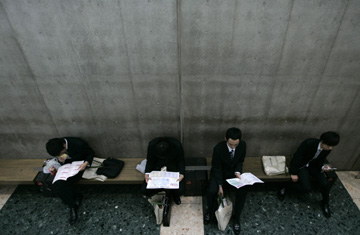
JOB SEARCH: Men look for work at a Tokyo job fair. Japanese firms have cut recruitment
As financial meltdown has turned into global economic crisis, the human cost in terms of lost jobs and displaced workers is growing at a terrifying pace. The International Labor Organization (ILO) predicts that 38 million people around the world could lose their jobs this year alone, sending unemployment rates in Europe and the U.S. into double digits for the first time in years and slowing — or in some places reversing — the massive jobs growth of recent years in Asia. Alarmed by the social and political consequences, governments, companies and labor unions in countries across the globe are scrambling to put in place a range of measures aimed at minimizing job losses.
For white- and blue-collar workers alike, shifting to shorter working hours and lower pay in exchange for tacit job guarantees is suddenly a no-brainer — not just in Britain, but also in Taiwan, Iceland and a swathe of other countries in Europe and Asia. Other schemes being tried include temporary work suspensions at factories, and even work-sharing programs. Two countries stand out as having the most developed and systematic approach: Japan and Germany, which both provide government subsidies to companies who keep on workers even though there's little or no work for them to do. Both have recently extended their schemes. In Germany, the government now subsidizes companies and idled workers for a full 18 months, up from six months, and the number signing up for the so-called short-work programs is soaring. In February, 724,000 workers were registered, more than double the number in January and 20 times the number a year ago. Most of the nation's auto makers including BMW and Porsche have adopted short-work programs in some of their factories. In Japan, too, the number of workers who have applied to the "employment-adjustment subsidy" program leaped sixfold between December 2008 and January 2009, to almost 900,000.
But in this gut-wrenching downturn, the Germans and the Japanese are no longer alone. "It's happening a lot," says Raymond Torres, director of the ILO's International Institute for Labor Studies. "People are trading off their jobs for wage cuts and other measures." There's even some anecdotal evidence that it's starting to happen in the U.S., where companies have traditionally not hesitated to lay off staff in a downturn; last month the New York Times announced a 5% pay cut for some of its staff in return for extra vacation days.
Torres and other labor experts say it's an open question whether these schemes make much of a difference. In the short term, they may well slow the rise in unemployment. But if the current crisis continues, as many economists are predicting, at least for this year and probably into 2010, even pay cuts, work-sharing schemes and shorter working hours won't be enough to safeguard jobs. "The real issue is can it be sustained?" Torres asks.
At the 30-nation Organization for Economic Cooperation and Development in Paris, chief economist Klaus Schmidt-Hebbel argues forcefully that governments should do more to retrain workers and overhaul their labor-market policies to ensure that once recovery comes, new jobs are created in sufficient numbers to swiftly bring the jobless rate back down again. But ask him about the German short-work measures, and he's skeptical. "They can't stop rising unemployment," he says, "they just delay it." Indeed, in its latest economic forecast released March 31, the OECD expects unemployment in Germany to rise from its current 8.6% to 11.6% by the end of 2010 — higher than many of its European neighbors — despite the special job-preservation measures. The organization expects Japan's unemployment rate will also rise, although less dramatically, to above 5.5% next year from 4% in 2008.
For all the economists' doubts, there's immense political pressure on authorities to do something to slow growing joblessness. Several national and regional governments are subsidizing job-preservation efforts along German and Japanese lines, sometimes for the first time. Regional authorities in Wales, for example, have just introduced an on-the-job-retraining scheme under which companies in trouble can receive a subsidy of up to $2,800 per worker if they keep them on the payroll and teach them new skills.
Where nothing else works, there's always political pressure. In India, airline Jet Airways reversed a decision to lay off 1,900 staff after the government made its displeasure known — and weeping victims melted Chairman Naresh Goyal's heart. "I could not sleep at night," Goyal confessed at a press conference. "I was mentally disturbed when I saw tears in their eyes." Civil Aviation Minister Praful Patel said he told Goyal that "the ministry would certainly not be very happy with the approach of Jet Airways." Something similar happened in France last month when the French oil company Total announced the closure of two refineries, with the loss of 550 jobs. The move provoked a furious public outcry including denunciations from two government ministers, and the firm quickly backtracked, saying it had been a "communication error." For companies receiving government bailout money, the pressure is even more intense: French President Nicolas Sarkozy has told Renault and Peugeot that the price for receiving subsidies during the crisis is that the auto makers cannot cut jobs in France.