

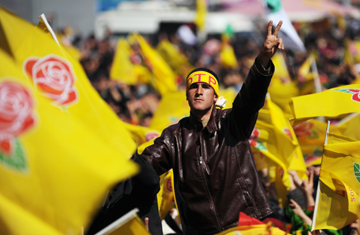
FLAG DAYS: A Turkish Kurd celebrates New Year
(2 of 2)
In 2004, a former JITEM member now living in Sweden went public with details of abductions he witnessed in the 1990s. He named Aslan's son and described how he was tortured, shot in the head and set on fire. Based on his description, Aslan drove out to a valley near Silopi and found bones near a tree by a riverbed. He badgered a local prosecutor who eventually put him on a bus to Istanbul with a plastic bag carrying the bones for forensic identification. The tests proved the bones were Murat's.
Four years ago, Aslan tried to have military commanders in charge of the region at the time of his son's abduction subpoenaed. The military has still not responded to his appeal. That snub doesn't surprise Kardas, the former military judge. "Turkey's most fundamental issue is how to get the military back into the barracks," he says. "The Kurdish problem is at the heart of that. The military have been deciding policy. If military officers committed crimes, they should be held accountable, but how?"
The carrot of E.U. membership is one way of scaling back the military's influence. "A chief condition of joining the E.U. is that the military is transparent and accountable to parliament," says Kardas. But that process has largely stalled, with European leaders divided over Turkey's future membership. New hope has arrived in the shape of U.S. President Barack Obama, who will visit Turkey next week and whose administration is keen to have Turkey — Muslim yet officially secular and democratic — play a larger role in the region.
But Turkey will need to deal with its Kurdish problem, including ending hostilities with a militant group, the Kurdistan Workers Party (PKK), who have about 3,000 guerrillas based in the mountains of northern Iraq. Turkish officials seem to recognize this. A trilateral commission of Iraqi Kurd, Turkish and U.S. officials meets regularly to discuss a possible PKK amnesty. Other measures on the agenda in Ankara include restoring Kurdish place-names and cleaning up the jingoistic billboards that litter the southeast. What's really needed is a more democratic constitution. But the government has backtracked on that promise before, and is weakened after losing support in local elections last month. "To make this sense of progress stick, we need Kurdish identity to be constitutionally recognized," says lawyer Elci. "Otherwise it will never be secure." Pointing from the window of his cramped office to the dusty town beyond he says: "This is the farthest point from democracy in Turkey. But it will get here."
It helps that Turkish Kurds now have a role model of their own. Kurdistan is still a taboo word in Turkey, but Turkish Kurds have watched with fascination the developments in neighboring Iraq over the past few years. Iraqi Kurds have built up a largely self-governing region with its own parliament and flag. For the first time in history, the Kurds — an ancient people spread out across Iran, Syria, Turkey and Iraq — have what looks like a state. "The emergence of Kurdistan has fostered a sense of self-confidence here," says Sezgin Tanrikulu, a prominent lawyer in Diyarbakir. "Not because people want independence. Or to live there. But it shows that there is indeed a distinct Kurdish culture. For a long time we were told 'you don't exist', 'there's no such thing as a Kurd,' and yet, look, there they are."
That first day in Silopi, the dig is called off. The prosecutor cites security concerns, the lawyers are despondent. But the next morning, the digger reappears and, this time, the gate opens. Every day since has brought reports of new bones. But as we drive out of Silopi, we pass convoys of tarpaulin-covered military trucks rumbling towards the Iraqi border, as they have every March in recent memory. Spring means a return to good weather, and fighting the PKK in the mountains. The trucks are a reminder that the road ahead for Turkey is long and bumpy. But change seems inevitable.