

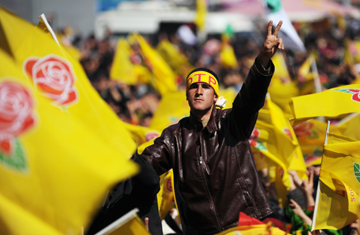
FLAG DAYS: A Turkish Kurd celebrates New Year
A yellow digger, creaky and crusted with mud, sits in front of a crowd of about 200 people outside a little-used military facility in the Turkish town of Silopi. The digger's engine hums. In a minute it will roll forward, past the grieving relatives dressed in their Sunday best, past the chain-smoking lawyers in somber suits, past blank-faced sentries and a television broadcast van beaming pictures around the country, and head on into one of the most controversial issues in Turkey's murky recent history.
In the 1990s, at the height of a dirty war fought against Kurdish separatists, state-sanctioned death squads allegedly killed hundreds of people and then buried them in unmarked pits, according to human-rights groups. Those groups estimate 5,000 people died; 1,000 have never been found. Now, like the pale crocuses emerging underfoot, there are stirrings of change across Turkey. For the first time, a public prosecutor has authorized excavation of one of the sites where missing Kurds are believed to be buried. The ruling represents something of a revolution in a country that has long oppressed Kurdish rights. "It would have been unthinkable, up until recently, for a solo prosecutor to order this search," says Umit Kardas, a former military judge who served in the southeast in the 1980s. "This gives me hope about Turkey's future."
The military presence in the mainly Kurdish southeast remains strong and the only Kurdish party in parliament constantly worries it will be forced to disband. But in other ways, change is happening. After years under a ban, the Kurdish language is flowering, the result of European Union-mandated reforms introduced in 2006. In Silopi, the same store that once secretly sold bootleg Kurdish tapes is now plastered with pictures of budding Kurdish stars. Language courses in the unofficial regional capital Diyarbakir are packed, writers' groups have sprouted and at the local theater, young actors are staging the city's first ever original Kurdish-language play (The Mutes). "Diyarbakir used to be a place where Kurdish was spoken, but never written," says municipal cultural coordinator Cevahir Sadak Duzgan. "That's changing."
In cinemas nationwide, I Saw the Sun, a controversial film about a Kurdish family whose two sons find themselves on opposing sides of the conflict, is No. 1 at the box office. And while using Kurdish spelling remains officially forbidden, people make a point of using their Kurdish names when they can. "Rojhat," says one bright-eyed 29-year-old lawyer, extending a hand when I meet him on a recent trip to the Kurdish region of Turkey. "Not Resat". (Unlike Turkish, Kurdish uses x and j.)
Even the state seems to be shaking its hard-line stance. In January, it launched a Kurdish-language television station with a flashy Kurdish singer as main billing. "The state is recognizing, in effect, that Kurdish is a language and that it can be used to deliver a public service like broadcast," says Ahmet Birsin, of Gun TV, a local station.
More change might flow from a landmark trial underway in Istanbul. The case pits the state against a shadowy ultra-right-wing network allegedly led by retired generals. Prosecutors accuse the group of staging bomb attacks and assassinations in a bid to overthrow the ruling Justice and Development Party and create a pretext for military rule. Turkey is no stranger to coups — the military has stepped in to push the government this way or that three times in as many decades. As recently as 2007, a veiled threat prompted early elections.
But the trial is the first time a coup plot has landed high-ranking military officials in court. The 40 soldiers now being held include a retired general and colonel believed to have cofounded JITEM, a secretive military-intelligence unit which many Kurds suspect is responsible for most of the dirty work in the southeast, including the extrajudicial killings of dozens of Kurdish activists. The Ergenekon trial — the group named itself after a mythic central Asian valley Turks believe they come from — "is a milestone," says Nuserivan Elci, who represents some 50 families of the 'missing' in Silopi. "It's a historic opportunity for Turkey to deal with its past."
Izzettin Aslan, a retired civil servant, knows how elusive justice can be. In 1993, his son Murat, a 24-year-old university student in Diyarbakir, stepped out to pay an electricity bill. According to witnesses, four men grabbed Murat off a busy street in broad daylight and pushed him into a waiting car. "It was as if the ground opened up and swallowed him," Aslan says.