

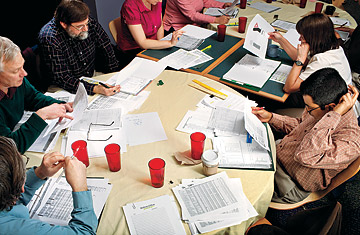
Skidmore admissions officers and faculty pick winners of a grant for talented science and math students.
Bob Shorb, Skidmore College's fast-talking director of student aid and family finance, did more reading than usual this year. And not just because the 4,000 financial-aid applications that landed on his desk made up a record 62% of the applicant pool. Shorb, who has worked in financial aid for 30 years and is halfway through putting his three daughters through college, had also never seen so many personal appeals folded into the files. Setting aside his computer algorithms and thick-buttoned relic of a calculator, he absorbed every typewritten page. One family expected a 50% income drop; another planned to sell its home to help pay tuition. A note from a family nearly a year behind on its mortgage made Shorb chuckle. "Unfortunately," it read, "we have not been bailed out by the $700 billion government rescue." (See pictures of the college dorm's evolution.)
Finding the funds to meet applicants' unprecedented financial need this year is a tall order for all but a handful of mega-wealthy schools, and as colleges decide how much they can afford to give, many worry they won't have enough to attract a full freshman class. Because private undergraduate colleges draw an average of 60% of their operating costs from tuition revenue, a student shortfall could cause a painful budget crunch, forcing schools to cut programs, slash faculty salaries and potentially raise tuition for students already enrolled. With admissions letters in the mail, many colleges are as nervous as the high school seniors waiting for word. Nailing the target class size is always "like landing a 747 in your backyard," says Skidmore president Philip Glotzbach. This year many colleges are prepping for the bumpiest landing yet.
Colleges of all stripes are taking a battering as endowments evaporate and the alumni-donation well dries up. But when it comes to actually getting its class in the door, Skidmore, which allowed TIME to observe scholarship discussions and review admissions and financial-aid applications less than two weeks before the school mailed its final decisions, typifies the unique dilemmas that face smallish private colleges. Schools with deep pockets are coping: seven of the eight Ivy League universities, for instance, notched application increases this spring, three of them in double-digit percentages. The same goes for state schools and community colleges, where the comparatively small sticker price is a big draw.
By contrast, Skidmore's applications tumbled almost 14% this spring, in line with plunges at seven of the country's top eight liberal-arts colleges and many others down the food chain. Skidmore's projected $51,196-a-year price tag makes it one of the nation's 10 most expensive schools, but its $223 million endowment--down 23% from its high about a year ago--is too small to bankroll financial aid for all who need it. Founded in 1903 as a women's college, Skidmore was long known for teaching art to well-heeled young ladies, but in its modern permutation as a coeducational college, it is a relative newcomer to national prominence and the donations that come with it. And while it's ranked among the top 50 liberal-arts colleges by U.S. News & World Report, administrators worry even that may not be enough to persuade students it's worth the higher sticker price.