

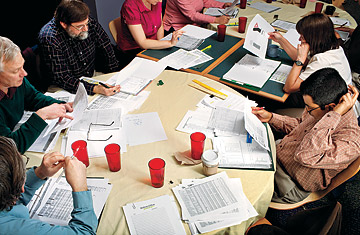
Skidmore admissions officers and faculty pick winners of a grant for talented science and math students.
(2 of 3)
At the 2,400-student college, nestled among sugar maples, beeches and basswoods at the foot of the Adirondacks in Saratoga Springs, N.Y., the decision-making kicks off Jan. 15, which is when applications for the incoming freshman class are due. Working in teams of two in their offices across the street from Skidmore's main campus, admissions officers are assigned about 450 applicants apiece, divided by region. Staffers paw through transcripts, essays and recommendations, sending the occasional art portfolio for faculty review and using spreadsheets to keep track of the students. When they finish, they hand the piles off to second readers. Certain files get special attention from Mary Lou Bates, dean of admissions and financial aid. Sitting at her desk in a converted Tudor carriage house, she reads every application from children of alumni (or "legacies"), students recommended by faculty or trustees and applicants who drew mixed reactions from the first two readers. (See pictures of eighth-graders being recruited for college basketball.)
The admissions officers are scanning for high scores and hotshot extracurricular activities, but they're also on alert for interest in Skidmore and evidence that a student will thrive in college. A young African-American woman from a Southern city, for example, had impressed Dean Mendes, assistant director of admissions, during their on-campus interview. The student recounted waking up at 4 a.m. to catch a bus to school when her family didn't have a car. Even though her hodgepodge of A's and B's didn't put her at the top of the academic heap, the grades were good enough to confirm Mendes' early impression that she would be a good fit. Accepted. A National Merit Scholar from California with a 3.88 GPA, by contrast, was a "remarkable" student, according to her U.S. history teacher. But on the application page that offered spaces to indicate whether she had visited the campus, browsed Skidmore's website or otherwise sought to learn more about the school, the student was 0 for 11. "No contact," scrawled an admissions officer. Waitlisted.
While the admissions committee churns through applications, Shorb is crunching the "expected family contribution"--in other words, the amount the students and parents are expected to pony up for school costs--in his student-center office not far from the bustling dining hall. He relies on two formulas, one federal, one from the College Board. Both use a fairly spartan set of assumptions about a family's saving and spending--instead of its actual habits. For instance, a Midwestern family earning $89,800 is expected, according to one of Shorb's algorithms, to put away $1,365 a year for its two children's education. By the time Bates and her team have selected their initial crop of accepted students, Shorb has made enough aid projections to sum up the potential admittees' total financial need.
In the final, "need sensitive" stage of Skidmore's admissions process, Shorb reports how much aid the school can offer and still get the class in under budget. Starting about March 1, the admissions committee does "triage," Bates says, scrapping some applications stamped FA-Y for "financial aid--yes," which are occasionally scrawled with a dollar amount. (Students who apply but don't qualify for aid are not penalized for trying; they get lumped in with the rest of the "full pays.") Needy applicants with weaker academic records, spotty senior-year grades or little apparent interest in Skidmore are booted to the waitlist. There were about 100 of those this year. To meet the final target number of acceptances--which Skidmore, to preserve its competitive edge, won't reveal--that left 214 spots for kids who could pay full freight. Personalized "Yes!" letters were mailed March 26.