

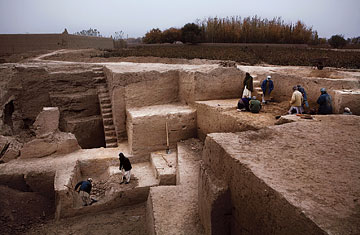
A newly discovered site at Tepe Zargaran, an ancient jewelers' hub near the city of Balkh
(3 of 3)
A Looter's Story
Ustaad Nasrullah, 65, considers himself an expert on Afghanistan's northeastern archaeological sites, not because he has been studying them, but because he has been looting them for 40 years. Ai Khanoum was one of his specialties, and he describes in detail the treasures that have passed through his hands. Coins and smaller items he sold to tourists, but anything substantial, like a stone statue of a naked woman, possibly a fertility goddess, went to brokers who were able to smuggle the items to Pakistan, where they fetched higher prices. Nasrullah is proud of his country's rich heritage, and struggles over the moral implications of his business. "It's true that we lose our culture by selling these things to foreigners," he admits. "But poverty is also awful. Most people don't know the meaning of these objects; they just know that if they find them they can buy food." He blames those who allow the practice to continue: corrupt government officials, warlords and the businessmen who market Afghan artifacts to the world. "They are the educated ones. They are stealing from Afghanistan. The poor are just trying to eat."
Afghan archaeologist Zaffar Paiman blames the Western art market for fueling looting. At a dig near Kabul, he has uncovered a 5th century Buddhist temple replete with exquisite plaster sculptures of the Buddha. He has seen similar statues, selling for upward of $10,000, at Parisian art galleries. "Looters dig because of international demand. Looters loot because a collector wants something nice for his living room. It's the same as opium in this country — we grow it because junkies want heroin."
If the scourge of opium can't be eliminated from Afghanistan, what hope is there for the country's disappearing antiquities? In 2005 some four tons of Afghan artifacts were intercepted at London's Heathrow airport. Authorities there are eager to return the cache, which is still stored by British customs — but to where? Afghanistan's one national museum doesn't have the security to protect the items, and many experts fear it wouldn't be long before several of the pieces returned to the black market. Archaeological sites are even more difficult to protect, says UNESCO's Cassar. "You have a government that can't extend its authority outside of the capital, so how can you expect it to protect sites far from the center? These are areas that would be difficult to manage for any government, and here there is a lack of funds."
Surprise — and Hope
The news is not all grim. seven years after the Taliban blew up Bamiyan's 1,500-year-old standing Buddhas, a French-Afghan team has found a third buried at the base of the cliffs where the others had been carved. Last winter, Japanese experts discovered the world's earliest known oil paintings in nearby caves, reversing common understandings about the origins of the art. Emilie Chicroun, a French mural specialist, calls it "a small revolution." Mixing oil with pigments had long been considered a European innovation, started in the 9th century; the Bamiyan paintings predate that by a few hundred years. "Now we will have to reconsider everything we think we know about the history of painting," says Chicroun.
The potential for a better understanding of history is reason enough for saving Afghanistan's archaeological heritage, says Cassar. But it goes deeper than that. By preserving its past, Afghanistan also has a hand in protecting its future. "The greatest contribution of these artifacts is that they show a different aspect of the Afghan story," says Cassar. "They are a symbol of the hope that one day Afghanistan can be known for magnificent pieces of cultural history and art, rather than terrorism."
— with reporting by Ali Safi/Kabul