

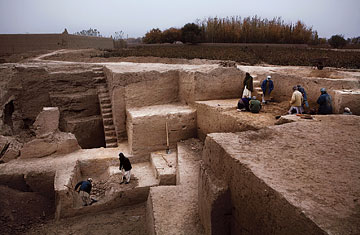
A newly discovered site at Tepe Zargaran, an ancient jewelers' hub near the city of Balkh
(2 of 3)
The mid – 20th century blossoming of archaeological research in Afghanistan uncovered treasures of unimaginable value: carved ivories, Greek statues and Buddhist icons that mesmerized the world. Those findings also ignited gold fever in the country, inspiring hundreds of freelance "archaeologists" to dig for treasures of their own, with a black-market value that far exceeded a farmer's annual earnings. Then, starting in 1979, war uprooted whatever fragile government protections had been put in place and thousands of priceless artifacts, some even looted from the national museum in Kabul, were spirited out of the country. But it was the fall of the Taliban in December 2001, and the subsequent power vacuum, that unleashed the most devastating rape of Afghanistan's heritage to date. "Ironically, poverty and war are what kept these sites safe," says Jolyon Leslie, head of the Aga Khan Trust for Culture, which promotes the rehabilitation of Afghanistan's cultural heritage. In times of conflict, civilians were afraid to leave home, he says, and the fear of land mines kept many from digging. Now that a nationwide campaign to clear the mines is bearing fruit, looters are returning to sites that have been untouched for years, and are even discovering new ones. "Given the price land mines exact, you don't exactly want to promote them," muses Leslie. "But it is tempting to put up warnings just for preservation."
Books with Missing Pages
At Tepe Zargaran, a newly discovered site near Balkh, there is no need to put up fake signs to ward off looters — most of the local diggers now working with the joint Afghan-French excavation team were once raiders themselves. Besenval shrugs: "That's the best way to neutralize them: give them a job."
Philippe Marquis, who leads the French archaeological team, points to a 26-ft.-deep (8 m deep) pit carved from the hill that exposes a cross section riddled with holes — like an ant farm pressed between panes of glass. He shows how looters dug wells, then tunneled horizontally when a promising layer was reached. (Looters, like archaeologists, know to look for signs such as ash or brick flooring for evidence of human habitation.) One such gallery has collapsed, so that it now seems just a jagged scar interrupting the smooth transition of history's layers. "It's like you are trying to read a book and some of the pages are missing," says Marquis. "Here we have lost an entire chapter in the archaeological novel."
As Marquis contemplates the mysteries of Tepe Zargaran that he will never be able to unravel, a shout rings out from the other side of the excavation site. Ahmad Basir, a grinning 19-year-old, holds aloft a clay urn the length of his forearm. It took Basir several hours of painstaking work with a scalpel to free the artifact from the earth where it had lain. Before the archaeologists came, he explains, looters would simply hack away at a site with axes and shovels until they found statues or gold jewelry. "We didn't care about pots," he says. "We would just throw them out, or break them to look for things inside." Marquis places the urn in a large ziplock bag and labels it with the date and exact location of the find. Once the dig is finished, all the artifacts will be shipped to Kabul where they will be analyzed and placed in a historical context, enabling the archaeologists to reconstruct what life once looked like at Tepe Zargaran. "We never knew this was important before," says Basir. "Now, when I find something like this, I am happy. A part of my history comes alive."
For every legitimate excavation like Tepe Zargaran, there are many more ransacked in search of treasures destined for the living rooms of rich collectors. The vast plain of Ai Khanoum, once the easternmost center of ancient Greek culture, is pockmarked with thousands of looter pits, some still containing fragments of clay or shattered lumps of marble — remnants of statues that didn't survive the excavation process. There is little left of the Corinthian columns that once lined the city's main thoroughfare, though at least two of the elaborately carved pedestals can be found at a nearby restaurant, where they form part of the foundation.