

Humans! They do like their words. Studies--by scientists who stuck recording devices on them and then counted--suggest that they speak some 16,000 words a day. Vervet monkeys, prairie dogs and European starlings have rudimentary language systems, but for serious verbiage, you have to hand it to Homo sapiens.
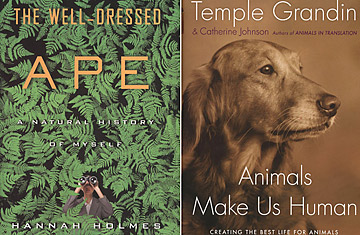
Take these two specimens. Hannah Holmes is a tall, blond, personally assertive science journalist. Temple Grandin is an eminent scholar of animal behavior who also happens to be autistic. These humans have written two books that look very different but are, in their warm-blooded, four-chambered hearts, very similar. In The Well-Dressed Ape (Random House; 351 pages), Holmes attempts to produce a thorough description of Homo sapiens using the kind of language we ordinarily reserve for animals. In Animals Make Us Human (Houghton Mifflin Harcourt; 342 pages), Grandin does the opposite: she describes animals in terms we usually associate with human beings. Both writers are after the same thing. They want to demolish the hard line that separates people from animals; you might call it the doctrine of human exceptionalism. They're both tunneling under the bars of the cage, but they're doing it from different directions.
Holmes and Grandin share the habit of putting everyday phenomena under the kind of scientific scrutiny usually reserved for giant squid and black holes, which causes them to notice things that regular civilians wouldn't pick up on in a lifetime. For example, Holmes points out that even though humans are covered in hair follicles--we have more of them than chimpanzees do--most of our fur grows in an "extravagant topknot" on our heads. In the context of the wider animal kingdom, this is a bizarre, even perverse evolutionary innovation. We also have more sweat glands than any other animal on earth--we can sweat almost a gallon an hour. We don't think of ourselves as poisonous, but our mouths are as full of noxious, infectious bacteria as is a Komodo dragon's, and a human bite can be seriously toxic.
The premise of The Well-Dressed Ape is that everybody knows human beings are really animals but nobody cops to it linguistically. Just talking about ourselves the way we talk about animals is a step toward self-knowledge. "We Homo sapiens," Holmes writes, "so eager to describe the rest of the world, have been chary about committing our own species to paper." Holmes describes us quite wonderfully, and she's a tireless compiler of biological trivia. She scours the extremes of the earth for anomalous and specially adapted humans, like the Tierra del Fuegians, who (before they died out) wore no more than a loose animal skin even in sleet and snow, and the Yana Indians of California, whose men and women speak different dialects. She has an engaging passion for rankings, as if all earthly fauna were competitors in an endless evolutionary Olympics. Our sense of taste, for example, outperforms a pigeon's and a tiger's (it turns out that tigers can't taste sweetness--sorry, Tony) but is crushed in turn by that of a lowly catfish, which has taste buds not just in its mouth but all over its body.