

(2 of 2)
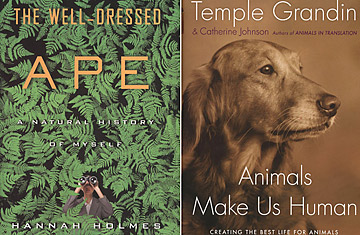
Grandin isn't much of a writer (nor, on the evidence, is her co-author, Catherine Johnson), but she's at least as astute an observer as Holmes, plus she's an actual scientist and an influential designer of humane cattle-handling systems. Grandin is also famous for being one of the world's most professionally eminent autistic people, which gives her work an ineffably distinctive perspective. In Animals Make Us Human, she's particularly interested in a kind of behavior called a stereotypy: an abnormal action that someone can't stop repeating. Autistic people often have stereotypies. So, it turns out, do unhappy animals.
Animals Make Us Human is a practical, species-by-species guide to making animals happier, grounded in Grandin's belief that "all animals and people have the same core emotion systems in the brain." For most people, her chapters on dogs and cats will be the most immediately rewarding--it never would have occurred to me that one reason cats' emotions are so hard to read is that they have no eyebrows--but there's a world of insight to be gained from her work on farm animals as well as more exotic zoo animals. Grandin shows a startling tenderness as she teases out what's troubling a wolf who couldn't stop pacing and a herd of antelopes who had panic attacks on their daily walks. (The culprit was a yellow sign; yellow is a scary color for many beasts.) Anybody who thinks autistic people lack empathy should read Animals Make Us Human.
There aren't many worse insults for a human than to be called an animal, but these books--which do just that, at great length--are instead strangely ennobling. They make you realize how much effort we expend every day convincing ourselves that we're different and what a relief it is to admit that we're not. It's lonely here at the top of the tool-using hierarchy--why don't we let down our fur and join the club? If they'll have us, that is. If animals could describe us in return, the results might not be so flattering.