

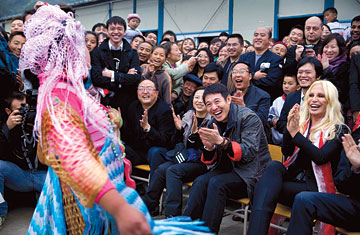
The cheer leader: Li, in Sanjiang with Donatella Versace, brings hope to earthquake survivors
(3 of 3)
Li has made five films — Born to Defence (1986), The Master (1989), Once Upon a Time in China (1991), Fist of Legend (1994) and Fearless (2006) — in which he protects his countrymen from cruel and rapacious foreigners, mostly Americans. In 1994's The New Legend of Shaolin, he is a Han Chinese rebel fighting against Qing (or Manchu, and thus foreign) rule. In Hero (2002), Li is an assassin who, to his own detriment, abstains from an attempt on the life of the Qin King, who goes on to become the venerated Qin Shi Huangdi, the first Emperor of China and the ruler who would unify the nation, standardize the Chinese language and commence construction of the Great Wall. And on it goes. If you want to picture Li's résumé, imagine it on red paper and bedecked with gold stars.
Of his films, Li considers the most important to be Hero, Fearless and 2005's Danny the Dog, in which he plays a senseless brute, trained to savage anyone running foul of his loan-shark master. "Everything I want to say is in those three movies," he declares. "The message of Hero is that your personal suffering is not as important as the suffering of your country. The point of Danny the Dog is that violence is not a solution. Fearless is actually about personal growth — about a guy who decides that in the end his greatest enemy is himself."
That is the thing about Li. He has spent more than two decades as a superior practitioner of on-screen violence, so all he wants to talk about now is oneness and universal concord. "The strongest weapon is a smile and the best power is love" is typical of the beatific remarks he ventures to anyone within earshot. The conventional explanation for this is that after a horrific near-drowning in the 2004 Asian tsunami, Li experienced a Siddhartha-style bolt of enlightenment and decided to abandon Hollywood venality for a life of good works. It makes great press, and Li does nothing to correct this idea, but the truth, naturally, is more complex. He was walking on a beach in the Maldives with his two small daughters and maid when the tsunami struck. The swells came up to Li's chin (he stands just under 5 ft. 7 in., or 1.7 m), but the group was able to struggle the short distance back to their hotel unmolested save for a slight injury to the star's foot. This was clearly a frightening experience, and the poor Li girls are scared of the sea still, but it is by no means among the first rank of tsunami survival stories. Rather than bringing on an epiphany, this relatively clement brush with death simply brought out the spiritual tendencies that Li had been harboring for years. The tsunami liberated him from the desire to make films.
Life After Life
Seven years before, at the age of 34 — when he stood upon the summit of the Chinese film world but had yet to venture into international markets — Li was already having existential ruminations. "I started thinking about life," he says. "I started wondering what it is people want. Is it money, power or fame? Is it to see yourself in TIME?" Over the next seven years his fame increased exponentially, but he was unable to completely enjoy it and ended up engaging over 20 different Buddhist teachers. "The main idea taught by the different kinds of Buddhism," he says, "is that the lower you put yourself on the priority level, the happier you become." Surveying the wrecked lobby of his Maldives hotel, Li recalled this lesson, and decided that philanthropy — a thing he had vaguely imagined doing in retirement — was not something that could be indefinitely deferred. Three years later, he had cleared his film commitments and established the One Foundation.
Today, he leads it from the front. At its Beijing offices, there are no p.r. minders corralling the visitor in an antechamber while the great man readies himself. He walks promptly into his own reception area with hand extended. Whenever he is in town (home is Singapore), he shares an apartment near the office with foundation staff, who must have scant hope of rest. He has addressed at least 20 conferences this year, espousing the kind of China that everyone wants to see. The most important point about the One Foundation, he says, is the example it sets, "so that when the Chinese become stronger we can take more responsibility in the world." In other words, it's not just about food parcels or blankets. It's about an idea of what the world's most populous nation can be. And that gets CEOs sheepishly arising from their cognac and shark-fin banquets to write checks. It makes the poor queue at post offices to offer gifts of a few grubby notes. It even persuades Italian fashion icons to sully their extravagant shoes in the mud of ravaged rural Sichuan.