

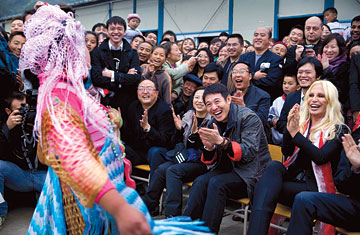
The cheer leader: Li, in Sanjiang with Donatella Versace, brings hope to earthquake survivors
(2 of 3)
The One Foundation's name carries unfortunate echoes of Li's 2001 movie The One — an execrable film, which borrows from The Matrix to an embarrassing degree. Its plot — Li plays a cop saving the world from a version of himself who arrives from a parallel universe and desires to become a god — is doubtless some sort of comment on the struggle between egotism and responsibility. But it's far better to think of the One Foundation as so called because of its essential idea: that if every able person in China were to contribute one renminbi (about 15 cents) once a month, then an enormous reserve could be built up for the relief of deserving causes (and thus create "one big family," to use One Foundation – speak). Although large corporate endowments are solicited and obtained, the soul of the enterprise really does lie in spare change. Ordinary Chinese donate by patronizing one of many businesses that Li has signed up — by dining at the South Beauty restaurant chain, for example (one renminbi off the bill goes to the foundation), or by using their China Merchants Bank credit cards. They can also donate at post offices, through PayPal or via SMS. By these means, the foundation had raised, as of July this year, $13.7 million, the great bulk of which has gone to Sichuan earthquake relief.
It's hardly the biggest charitable sum that China has seen. Property magnate Zhu Mengyi has given away $160 million in the past five years (and the octogenarian entrepreneur Yu Pengnian has set aside well over twice that for the provision of cataract operations). But the One Foundation is not about billionaires. It is about a celebrity who has forsworn a pleasant life of premieres and parties, and the ordinary people who support him with their pennies. It is for them, perhaps, that Li places an almost neurotic stress on the One Foundation's "transparency" and "professionalism." He says he wants to run the organization "like a listed company" and make it a "21st century charity." Before discussing how a single cent has been raised, he speaks of "best practices," explains how the foundation's finances are independently audited by Deloitte, and name-checks Boston Consulting Group and McKinsey as his management partners. Scores of funds were established in the wake of the Sichuan calamity — in fact the public's response to the disaster marked an epochal shift in the whole business of Chinese philanthropy. But the One Foundation's businesslike style and the way in which it has made charitable giving a matter of a mouse click or a text message hopefully presage the sector's future.
Fighting for Nonviolence
To the rest of the world, Li's show-biz sabbatical may appear abrupt, but to his countrymen he is reprising the major themes of his life — self-sacrifice, service and discipline. At the age of 8, Li was randomly enrolled in a wushu class during a summer sports program. He had no idea what wushu was, which isn't surprising. At that time, wushu was only 13 years old. It was a committee-ordained synthesis of the various age-old Chinese combat forms (wushu literally means "martial arts"), intended to create a new codified sport. Emphasis was placed on the solo execution of martial stances and routines, and the system of point-scoring rewarded purity of form. In effect, it was a Chinese form of gymnastics, and Chinese officialdom was rather proud of it, making it an integral part of the country's cultural-exchange program. It reached thousands of foreign spectators, who fancied they were watching something ancient instead of the hypermodern creation of a socialist state.
Young Li was among the performers who accompanied Chinese delegations around the world, and his extraordinary ascent through the sport has never been duplicated. At the age of 11, he was part of a troupe sent on a goodwill tour of America and performed in front of U.S. President Richard Nixon, who jokingly asked the young fighter to become his bodyguard. Li's precocious reply — "I don't want to protect an individual; I want to defend my 1 billion Chinese countrymen!" — was regarded as a great propaganda coup by Chinese apparatchiks, whose darling he became. Li also became, at the age of 12, China's national wushu champion — not junior champion, but champion, period. He held that title for the next four years and performed in over 45 countries before his 18th birthday, trotted out like a national mascot. "I felt like I was carrying a lot of responsibility," he says. "I felt like I was representing a billion people and needed to do good."
You can see those sorts of sentiments running through Li's film corpus. In Bruce Lee's action movies, the Eurasian outsider fought for no greater cause than himself (the sole exception is 1972's Fist of Fury, in which he battled the cocksure Japanese). Jackie Chan made the action-comedy subgenre his own, reducing martial arts to a form of slapstick. Li, however, has most often played the sober upholder of national pride.