

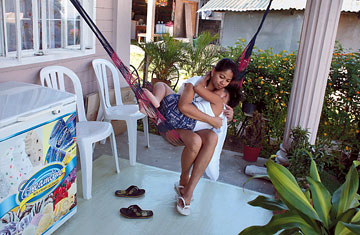
Separation anxiety: For Shyrelyn Diaz, going abroad would mean leaving her son
It's almost time for dinner in little Italy. A man walks along the street in shorts, dangling a cigarette from one hand, pushing a stroller with the other. Kids mill around a basketball hoop missing its net. Men chat on a porch nearby. Twenty years ago, people from Mabini, a small city in the central Philippines, started to leave for Italy to find better-paying jobs. Today, some 70% of the neighborhood is supported by monthly checks from Rome or Milan. Now, Italian-inspired villas crowd the town's hilly streets. There are flat-screen TVs, luxury cars and pricey Toblerone chocolates. But, as Florian De Jesus, a social worker in the area, observes, "In Italy, there are more women."
In recent years, the Philippines has faced an unprecedented exodus. Though millions of men have come and gone to work overseas over the past century, the world's ever-increasing demand for "female labor" like caregiving and domestic service has swung open the exit door for the nation's women. Today, about 8.7 million Filipinos — some 10% of the population — are registered with the government as overseas workers. Thousands of workers leave the country every day, and half of the new hires are women, flying off to earn salaries that are propping up the country. Last year alone, overseas workers sent home $17 billion in cash remittances, according to the World Bank. "Without the remittances, our economy will instantly collapse," says Dr. Honey Carandang, a clinical psychologist and professor at the University of the Philippines. "The whole country knows it."
What people don't know is what the Philippines will look like when the millions of children these workers are leaving behind grow up. A UNICEF-commissioned study estimates that roughly one in four kids — about 9 million children nationwide — have at least one parent working abroad. More and more, that means a mother living halfway around the world for 10 or 15 years at a time. The government rightly applauds "Overseas Filipino Workers," or OFWs as they are commonly called in the country, as heroes for the sacrifices they make for their families. But while children whose mothers are nurses in Canada or housekeepers in Hong Kong often go to good private schools and have MP3 players, there is a growing sentiment that trading global dollars for a generation raised on cell-phone minutes is a raw deal. Carandang, who works with families of migrant workers, named her most recent book after one boy's lament for his mother working as a caregiver in the Middle East: "The light of the home is gone."
Mabini, a city of 41,000 overlooking the clear waters of Batangas Bay, used to be a busy farm town, where loaded trucks left twice a week carrying fruit to Manila. Today, nobody is making a living off the land. The local markets' produce comes from somewhere else, and the cost of living is inflated by residents' foreign salaries, which are easily 10 times local wages. In Little Italy, many workers have built sprawling, European-style homes — some complete with sweeping marble terraces, faux stone façades and fountains — years before they plan to return to the Philippines. The houses sit empty, waiting for the day that their owners have put their last child through school and amassed enough health insurance, life insurance and retirement money that they feel they can return home.
Many parents go abroad hoping to finance a better future for their children. The country's public schools are overcrowded and underfunded, and that's not likely to change anytime soon. The Philippines' young population — over 35% of the nation is 14 or younger — is on track to double between 2000 and 2030, sending tens of millions more into the workforce. With some 30% of the population stuck in poverty and 7.4% without jobs despite the nation's steady economic growth, Filipinos see few opportunities at home. Isabel Pedrosa, who lives in a village near Mabini and whose 20-year-old son has been immobile since birth with severe cerebral palsy, says her family's state health insurance covers some bills but not all of them. Her husband is a construction worker in Qatar. "If not," she says, "we wouldn't be eating three times a day."
The notion that being able to feed your family means leaving the Philippines is a message kids are quick to internalize. Kay C Mendoza, who never knew her father and whose mother has been working overseas since she was five, lives in Mabini with her siblings. Her aunt lives nearby and checks in on them daily. She has a typical 13-year-old's concerns about gossip and boyfriends. But Mendoza is also already planning her career overseas. "I'm going to work hard so my mother can come home," Mendoza says.
Ending this cycle of emigration won't be easy. Aileen Constantino-Peñas, who works for the NGO Atikha, says part of the problem is that most children of migrant workers "do not have the slightest idea of the difficult situations their parents face." More and more women are leaving to work in private homes as domestic helpers, a job that can mean putting up with long hours and cramped living quarters — and, all too often, abusive employers. But few of the grim details get shared in the regular phone calls parents make home to their kids. Through workshops like "Scrubbing Toilets is Never Fun," Atikha tries to urge kids like Mendoza to reconsider following in their parents' difficult footsteps.
Not every woman has made the heartbreaking choice to leave Mabini. Shyrelyn Esguerra Diaz — "Baby" to her friends — still lives in Little Italy with her 5-year-old son Magnus in a comfortable home with high ceilings and a grassy yard out front. Sitting on the couch next to his mom, Magnus lets out a wheeze of concentration, his chubby thumbs flying on a video game, while Diaz wonders aloud whether she should move to Rome, where she can earn more money and join her husband who already works there. When Magnus first overheard her saying that her work permit had been approved, he asked, "If you leave, who will I eat ice cream with on the lawn?" The innocent question haunts her. "Simple, but ..." She finishes the sentence by miming a knife jabbing into her chest.