

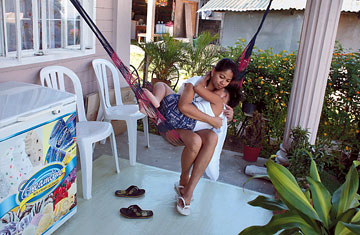
Separation anxiety: For Shyrelyn Diaz, going abroad would mean leaving her son
(2 of 2)
Yet once kids become parents themselves, they face the same choice their parents did. When Baby Diaz was in elementary school, her mother and father moved to Italy to work. When she was 18, her four siblings did, too. The family supported her while she stayed in Manila to go to university, but she says the feeling of being deserted has never left her. Now 27, with a good local job as a bank teller, Diaz has to decide whether to join her entire family in Italy, where she'd make more money even as a domestic worker, or stay in Little Italy and raise Magnus alone. "I know my parents worked so hard for me to finish school so I could get an education and not go into domestic work," she says. And Diaz does not want her son to go through what she did. "The income I could earn could not compensate [for] the loneliness," she says.
Still, she has not said no.
Family Values
The Hospicio De San Jose is a hushed haven from central Manila's crushing heat and traffic. Inside the orphanage's dormitory, Sister Socorro G. Evidente points through a window to Pauline, a 2-year-old napping in the dark, thumb in mouth. When she was a week old, Pauline was left by her mother, who said she was going to work in Dubai. She never came back. Some mothers, Evidente says, "do not even bother to send any money for their kids ... The children grow up feeling like they're really abandoned."
Children with homes to call their own are also struggling. According to a new UNICEF study, Filipino teenagers with one or both parents abroad, though they do better in school and have more allowance money, said they felt they were worse off — particularly when it came to their future — than peers with both parents living at home. Past studies have also shown that children with mothers abroad report feeling less happy than those with fathers abroad. "One parent can a do good job, but that doesn't happen a lot," says Dr. Esperanza A. Icasas-Cabral, the Secretary of the Department of Social Welfare and Development. "The social cost is great." But no government data exists for tracking the social progress of migrants' children, and that, social workers say, is a problem when millions of kids are thought to be at high risk for early pregnancy, incest, drug abuse and depression. Manila police, for instance, say that children with parents overseas are more exposed to violent crime, particularly rape and physical assault. "There are no parents watching," says Manila Police Officer Dolores Villegas.
Even when parents return, the sting of abandonment can linger. In a dimly lit living room in suburban Manila, Rebecca Lucero watches her teenage son, John Patrick, bolt past and pound up the stairs. Lucero says he is a good kid. He does well in school. But, she adds, "I feel uncomfortable around him." She gave birth to her son, now 18, when she was working at a Holiday Inn in Abu Dhabi. She took him back to Manila to live with her mother when he was 3 months old, and left him there for 11 years while she continued working in the Middle East. "Now, sometimes when we fight, he'll say, 'Why did you leave me?'" Having spent all those years away, she says, "Even if I gave him material things, it's not enough."
No End in Sight
Officially, the Philippines knows it can't sustain having 10% of its population gone for decades at a time, particularly when a worldwide economic recession means fewer jobs overseas and smaller remittance checks sent home. During an October meeting on global migration in Manila, U.N. Secretary-General Ban Ki-Moon warned that millions of migrants were at risk of losing their jobs in the wake of the financial crisis — grim news for both individual Filipinos and their government. By law, the government isn't allowed to promote overseas employment. But the Department of Labor does arrange state-to-state labor contracts that send workers abroad and openly encourages private-sector recruitment for overseas jobs. Evidence of its success, in the form of advertisements for English courses, technical schools and recruitment centers, is plastered across buildings and telephone poles throughout Manila. "It's a global phenomenon; we have to accept it," says Vivian Tornea, a director at the Department of Labor and Employment's Overseas Workers' Welfare Administration (OWWA).
Funded by the $25 fee each legally departing worker pays to the government, OWWA runs programs to support its globetrotting workforce, including mandatory predeparture orientations, free life insurance, a voluntary savings plan and, when workers return, family counseling, free job training and access to scholarships and loans. Migrant workers are also required to buy national health insurance, which extends to their families. But as more and more women leave, the government needs to step up its efforts to develop programs that specifically address the needs of workers' kids, says UNICEF. "We want children and families to be involved in every stage of the [migration] process," says Mary Grace Agcaoili, a social-policy specialist with UNICEF in Manila.
Others say the best way to help families is to dam the flood of migration by giving workers a reason to stay home. In October, officials said that nearly 10 million jobs had been created in the Philippines between 2004 and 2008. But activists and labor organizations argue that many of those were part-time or low-paying — hardly an enticement to keep Filipinos from seeking their fortunes overseas. "We want people to go abroad to work as a choice — not as something they have to do," says Cabral, head of the Department of Social Welfare and Development.
On the sidewalk outside Manila's Ninoy Aquino International Airport a crowd is milling in front of the overseas-worker processing office. Dozens of families — some red-eyed, others laughing — hang around, trying to draw out their last moments together. "This is normal," says Amie S. Catigbe, who has just parted with her sister again. "Everybody hugging, crying." She winces. "Sad." On the tarmac, planes are ready to scatter families to Dubai, to London, to Rome, to Hong Kong. Women sit in window seats, bracing themselves for another year, or another three years. As night falls, they watch Manila spread out beneath them. The lights of their houses are on, but the lights of their homes are already gone.