

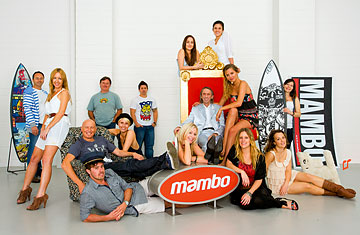
Catching a new wave: While a couple of his staff are a link to the past, managing director Kingsmill has focused on hiring youth and energy
How do you know when a company is losing its way? With Mambo Graphics, a clue for co-founder Dare Jennings lay in the way some of its people were handling the firm's star artist. This was the early 2000s, after Jennings and Andrew Rich had sold the company for a rumored $20 million to the giant rag-trader Gazal Corporation. Having stayed on as creative director, Jennings was amused to see certain staffers treating Reg Mombassa like a tradesman. "They would come to me and say, 'Can Reg do something for us?' Later it would be, 'Now, Reg, this is what we want you to do.' It's just not how it works. Reg does something for you and that's what he does. And you use it."
Gazal and Mambo went together like pepper and jam. A public company based in the artistic dead zone of Banksmeadow in Sydney's south, Gazal generates annual revenue of $160 million and licenses a suite of brands including Oroton and Calvin Klein. Mambo was no Ma and Pa store in its heyday, either: it had outlets on three continents and annual revenue of about $40 million. But right from its 1984 launch in a Sydney motel, Mambo in spirit was always the quirky interloper contending with surfwear's super-heavyweights, the all – Down Under trio of Billabong, Quiksilver and Rip Curl.
At Mambo's heart were Jennings and a handful of mates from Sydney's art and music scene, who turned their irreverent and sometimes off-color whimsy into the loaded words and striking images that defined the Mambo brand. The drawings were seldom sophisticated, often focusing on human anatomy and bodily functions. But along with Jennings' habit of donating a share of profits to left-wing causes, the art made Mambo exceptional in business, where the tweaking of a logo can qualify as a creative masterstroke. "Mambo was a community," says Jennings. And for more than 15 years, it thrived.
Jammed into a corporate culture, however, the stirrer lost its sting. In May last year, resigned to Mambo's dwindling sales and street cred, Gazal announced it was offloading the brand, which a private consortium snapped up in January for about a third of what Gazal had paid for it eight years before. The new owners' plan is to revert to the original Mambo recipe of humor, social commentary and art, while stirring in a fistful of contemporary spices. Co-owner Angus Kingsmill told TIME: "We believe Mambo has massive global potential. It would take almost a perfect storm to stop us." In the shape of the meltdown on financial markets, something like that storm is rattling the windows of businesses across the world. Preparing for Mambo's November relaunch, Kingsmill concedes that securing capital has been hard lately. "But we're still growing Mambo against all the economic trends."
In the mid-1980s, when Kingsmill was an easily distracted Sydney marketing student, a go-to item in his wardrobe was a T shirt declaring "Live Fast, Die Young in a Nice Pair of Shorts." It was one of Mambo's more benign items. Still to come were Mombassa's "Australian Jesus at the Football" and his design protesting plans for an expanded nuclear facility at Sydney's Lucas Heights: "Mr and Mrs Sydney would prefer not to have a nuclear reactor situated halfway up their arse."
Last year, an old college friend of Kingsmill's, Bret Merriman, suggested they go after Mambo. At that stage interest was high, and Kingsmill thought they'd be priced out. As a successful footwear importer, Merriman, along with the third director, accountant Anthony Woodward, assembled the consortium and invested heavily in it. They wanted Kingsmill as frontman for two reasons. One was his grasp of the surf industry. For three years from 1999, Kingsmill was general manager of beachculture, a retail chain that grew on his watch from eight to 21 stores in Australia and New Zealand. In 2005, he bought into former ironman Guy Leech's eyewear company Odyssey 20/20, which the pair sold the following year as a market leader.