

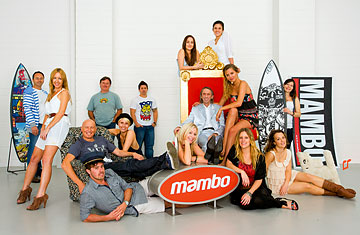
Catching a new wave: While a couple of his staff are a link to the past, managing director Kingsmill has focused on hiring youth and energy
(2 of 2)
The other quality Merriman valued in his friend was charm. Friends extol Kingsmill's knack for putting others at ease, using his wit to disarm the prickly and draw out the shy. A brand builder who likes his humor with a Seinfeldian twist, Kingsmill seemed the right man to rebuild Mambo, to persuade retailers that the entity most people thought was lost at sea had been found, revived and set on a course that could make it stronger than ever.
The morning after the acquisition, Kingsmill and Merriman powwowed in a café in beachside Manly. For managing director Kingsmill, high on the to-do list was meeting with Jennings and Mombassa. A founding member of the celebrated band Mental As Anything, Mombassa never formally cut ties with Mambo, but in the Gazal era they frayed to a thread. In the old days, Mombassa would fill his notepads with sketches and show them to Jennings. "Dare was willing to run with stuff that wasn't going to be commercial," says Mombassa, "because he wanted to make a point." In the Gazal period, when the sensibilities of a board of directors ruled, that idealism faded along with Mombassa's interest.
Kingsmill wanted him back. And once Mombassa decided the new managing director was right, he agreed. But can 57-year-old Mombassa still conjure the bizarre imagery that marked his early Mambo work? "I'm just as childish and ridiculous as I was then," he says.
Another link with the past is Wayne Golding, who bluffed his way into the art room in 1984 and rose to become the company's chief copywriter. Convinced Mambo was dying under Gazal, he left the fold for 14 months but is now back, a wise head in a smart young team. "To many at Gazal, Mambo could have been a breakfast cereal or a box of dog biscuits," says Golding. "There was a failure to appreciate that we were at the élite end of the hard-core surf market." The brand hadn't moved with the times, persisting with oversized clothes and huge graphics long after a sharper look became de rigueur. Its youth appeal dipped when kids spotted Mambo tees and shorts on the middle-aged, then plunged in 2006 when Gazal shifted Mambo stock from surf shops to department stores. From those '90s peaks of $40 million, in 2007 Mambo turned over $10 million.
For Mambo's new HQ, Kingsmill snared a warehouse-style set-up in North Manly, in the heart of Sydney's surf scene. For their $7 million, the new owners acquired the Mambo brand everywhere except the European Union, as well as the nine Australian stores, which Sydney architect Kelvin Ho will refurbish, Kingsmill says, with a "gallery-type feel."
But the clothes are the thing. Kingsmill assembled a design team headed by Elisha Guilfoyle, fresh from a stint in Ohio at Abercrombie & Fitch, and Ben Noble, previously of Quiksilver. There'll be a sharper difference between the men's and women's ranges. Kingsmill is betting that women aren't so interested in jokes and slogans but will embrace a range that celebrates what he calls the "quintessential Australian beach babe," to be embodied by Sydney model Cheyenne Tozzi. Mambo will stay in department stores but also return to surf chains. If all goes well, says Kingsmill, its nine outlets in Australia could become 20 within three years. He also plans to expand into the U.S., where classic Mambo T shirts have been traded on ebay for up to $250.
The new team's challenge is to move the brand's appeal from nostalgic baby-boomers to their children. "Brands have to evolve," says copywriter Golding. "The new guys are charismatic and well-connected. If anyone's going to pull this off, they are." While the economists deliver dark prophecies, the brand that gave Australia its own beer-and-pie-giving Jesus is poised to make a Second Coming of its own.