

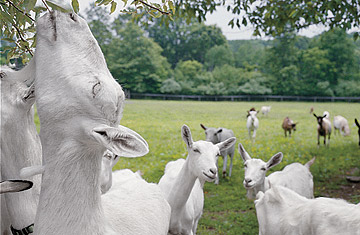
Goats near Hopewell, N.J., are slaughtered on site before Chef Michael Psilakis make roasts, chops, and more.
All Goats, apparently, go to hell. The Bible is quite clear about this in the Gospel of Matthew: when Christ returns, he'll separate the goats from the sheep and send the sheep up and the goats down.
That is a shame. In the 20 years my uncle has spent raising goats, I've known the animals to be extremely cute and fairly intelligent (for livestock) and, importantly, delicious. So when it came time to have a big summer barbecue, I thought of the long-maligned goat. Sure, it has been absent from American haute cuisine since, well, forever, even as meat fads like emu and ostrich have come and gone. But it's one of the most popular meats in the world, and immigrants from South Asia, the Caribbean and Latin America are importing a taste for it to the U.S. There's a lot for non immigrants to like too. It has much less cholesterol and saturated fat than beef or pork and is much easier on the environment. Goats have small hooves that don't tear up pastures, and they don't need a lot of expensive grain or water.
Even though the number of U.S. meat goats is on the rise (up 25% since 2005), if you want fresh goat meat, you might have to kill it yourself. That's what we did.
I had enlisted Manhattan superchef Michael Psilakis to be a guru of sorts for the barbecue. Lamb and goat were a big part of his growing up in a Greek family on Long Island, N.Y.--not just cooking them but killing them too. And his successes as a restaurateur--one of his places, Anthos, was recently nominated for best new restaurant in America by the James Beard Foundation--apparently haven't slaked his thirst for warm, runny death. "I've slaughtered just about everything there is to slaughter," he told me. "It really makes you respect the food." I couldn't do this barbecue right, he said, unless I was there for the slaughter.
Ultimately, it was the right thing to do--or at least the typical thing. Few super markets sell goat, and those that do are likely to import it frozen from as far away as New Zealand. That's because most U.S. slaughterhouses won't process goats--at 65 lb. or so (30 kg) on the hoof, a goat doesn't have enough meat to make the kill worth it in the era of factory farming. So rookies in the goat-raising business are warned that they may have to provide a place on the farm where customers can kill the animals they pick out.
Our place was behind a barn near Hope well, N.J. Logistically, it was pretty easy; all we needed were a sturdy rafter, some twine, a sharp knife and a bucket. Emotionally, though, it was more complex. Meat is, unavoidably, murder. But we were quick and merciful, and I think assisting in those two deaths made me a more conscientious carnivore, just as Psilakis had promised.
After we skinned the goats and dressed them, we aged the meat for a day, and then in a nod to enthusiasms for chevon around the globe, we used one goat to cook an Indian curry, a Mexican birria and an Italian capretto. Psilakis also kicked in a stunning kokoretsi (sort of a Greek haggis) plus sausages and a terrine--all terrific dishes made primarily from offal.
The coup, though, was the whole roasted goat. There are full roasting instructions and recipes on the next page, but Psilakis essentially trussed the entire animal (sans head) to the spit and roasted it over in direct heat for six to seven hours, basting it constantly with a mix of lemon juice, olive oil, oregano and salt and pepper.
Goat is a lean meat, but when it's cooked slowly like this, it is completely tender and flavorful, like a fortuitous cross between pork and beef. It was good. So good, in fact, that if goats really go to hell, with all that slow roasting and fire, I might just want to join them there.