

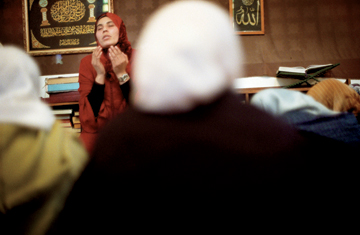
INSPIRED: Morocco's female preachers say they take their cue from the Prophet Muhammad's strong, opinionated wives
The three teenage girls sniffing glue in the back of the bus must have thought the fumes had melted their brains. Here they were in the North African kingdom of Morocco, riding into a slum in the town of Salé. Yet as they peered through the window of the bus, they could see a giant poster on the side of a house, featuring a leering Saddam Hussein holding a rifle. Stranger sights lay ahead: as the bus rounded a corner, the street was full of Iraqis and American soldiers in Humvees.
"They're filming a movie. We're supposed to be Baghdad," one passenger explained, and the girls returned to their glue. Sure enough, director Ridley Scott was shooting a political thriller starring Leonardo DiCaprio and Russell Crowe, and Morocco — with its deserts, craggy peaks and labyrinthine bazaars — was his tame cinematic stand-in for Iraq.
Hollywood isn't alone in wanting to turn Morocco into Iraq. Al-Qaeda, and a small but virulent band of loosely associated jihadis, would also love to make their mark in this nation of 34 million. They see corruption, spreading slums and 15% unemployment as fertile ground to sow their extremism. Similar conditions in neighboring Algeria gave rise to an ongoing civil war between security forces and armed Islamists that has left 150,000 dead. Morocco is next in the jihadis' crosshairs.
It so happened that one of Morocco's weapons against this jihadi fantasy was also riding the bus that day, a seat in front of the glue-sniffing trio. With her chubby cheeks, quiet voice and large glasses, Fatima Zohra al Salfi makes an unlikely heroine, and she's clearly nervous about a few of the sinister-looking passengers on the bus. What al Salfi has going for her is the same thing the jihadis have: religion. She is a murshida, a Muslim "guide" or preacher, and as such a rarity in the Islamic world, in which religious instruction is usually the preserve of men. The government-sponsored religious training that al Salfi and other female preachers have undergone is unique in Islam. But Moroccan officials say other countries, including Egypt and the United Arab Emirates, have also expressed keen interest in the idea of using a woman's touch as an antidote to extremism.
Al Salfi knows the Koran by heart and is prepared to do battle with the Islamic extremists on their turf — in prisons and in shantytowns where sometimes the only escape from despair is through the fumes of glue or hashish or a DVD of an al-Qaeda sermon extolling the pleasures that await a martyr in paradise. "If I found someone who wanted to blow herself up," says al Salfi, "I'd recite a verse from the Koran telling her that in Allah's eyes, suicide is the road to perdition."
But her mission is not just a matter of combatting extremism. Al Salfi and the other 200 women graduates from the Ministry of Islamic Affairs' new training school for murshida also want to help restore what they see as women's rightful place within Islam. They take inspiration from the strong and often opinionated wives of the Prophet Muhammad. One wife, Khadija, helped him recognize that Satan once came to him disguised as the Archangel Gabriel; another wife, Aisha, was the source for many of the sayings and deeds of Muhammad, who trusted her wisdom and integrity. "For centuries, women have been distanced from religion, from the pillars of Islam," says Rajaa Naji El Makaoui, a law professor in Rabat who, in 2003, was the first woman ever invited to give a speech at the royal palace during Ramadan, the holy month of fasting. It is time, she adds, for women to assume their equal role once more. Or, at least, almost equal. The female guides perform nearly all the same functions as male imams, or preachers, except that they are not allowed to deliver the Friday sermon in mosques.
In conservative Morocco, these female preachers could never have gained acceptance without a nod from King Mohammed VI, a progressive when it comes to women's rights. One of the monarch's first decrees on ascending the throne in 1999 was to throw open the doors of his father's harem in Rabat, pensioning off dozens of concubines who had rarely been allowed outside the palace walls. He later pushed for a reform in family law, giving women more rights than in most Muslim countries in matters of divorce, property and her husband's choice of subsequent wives. (Islam permits up to four wives, but in Morocco the first wife must now approve of her husband taking additional wives.) The result: divorce is up, polygamy down.
A Kinder, Gentler Faith
Inside the Salé shantytown mosque, more than 300 women of all ages are waiting for al Salfi, whose voice gathers volume and fluency as she warms to the subject of how women should behave in a mosque. Lesson 1: Refrain from gossip. Afterwards, women tell her of their family woes, confiding about the daughter turned prostitute, say, or the drunken husband who punches his wife. "Sometimes it's as much about psychology as it is religion," says the murshida program director, Mohamed Amin Chouabi, who notes that their year-long training teaches the women preachers how to deal with modern-day problems ranging from aids to alcoholism.
Indeed, the murshidas' role is in part to protect Moroccans from the moral dangers that modernity brings. Islamic Affairs Minister Ahmed Toufiq told TIME: "The world is wide open. We have satellite TV in the highest villages of the Atlas mountains, and we can't escape these alien influences. All we can do is find an immunity within the body."