

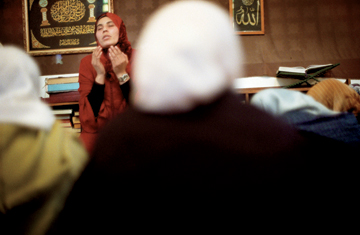
INSPIRED: Morocco's female preachers say they take their cue from the Prophet Muhammad's strong, opinionated wives
(2 of 2)
The best immunity, says Toufiq, is to revive the kinder, gentler form of Sufi Islam that spread through North Africa and Spain between the 9th and 13th centuries, a golden age known for its art, philosophy and tolerance. This is the kind of Islam that Toufiq is trying to recreate in the training schools for women guides and male imams. Not only the Koran is taught — so, too, are Greek philosophy, Christianity and Judaism.
This Islam stands in direct contrast to the puritanical version preached by today's jihadis. Says Toufiq: "These extremists say we're infidels because we don't pray correctly — even if I'm a Muslim and I believe in Allah and his Prophet Muhammad. We didn't think these people existed here until they started blowing things up."
The wake-up call arrived in May 2003, when al-Qaeda suicide bombers killed 45 people and wounded dozens of others in Casablanca in explosions outside a luxury hotel, a Jewish center, a Spanish restaurant, a social club and the Belgian consulate. Since then, Morocco has been rocked by scattered acts of terrorism, and in February police arrested 38 people who were allegedly members of an extremist gang suspected of pulling off robberies in Europe in the mid-1990s to bankroll a plot to assassinate Moroccan ministers and police chiefs. "We also know that Moroccans are feeding into the pipeline of foreign fighters going to Iraq," says a Western diplomat in Rabat. A disproportionate number of them, he adds, end up as suicide bombers. Police say that since February they have arrested more than 70 suspected extremists and broken up two jihadi cells that funneled recruits to Iraq.
Jihadis challenge one of the pillars that have kept the Moroccan monarchy stable since independence in 1956: the idea that the King, as a direct descendant of the Prophet Muhammad, is a Commander of the Faithful — a temporal and spiritual ruler rolled into one. When Mohammed VI first came to power, this exalted title jarred with his public image as a rather shy leader less enthused about statecraft than about computer games and the water sports that earned him the nickname His MaJetski. His relaxed behavior in the first years of his reign made him an easy target for jihadi propagandists. But after the Casablanca bombings, the King began to assume more control: he ditched a few of his late father's widely unpopular courtiers, signed off on a budget for rural education — literacy countrywide is 52% — and built low-income housing in Casablanca and Rabat.
Mohammed VI predicted that the terrorist attacks in Casablanca would be the last to jolt the country. But that forecast proved overly optimistic, despite the jailing of more than 500 suspected Islamists. Moreover, says Hakim El Rissai, a senior researcher at the Moroccan Association for Human Rights, the police crackdown has only fueled resentment against the regime: "The police here aren't very methodical. They arrest 200 people to catch one terrorist." This repression, adds El Rissai, "is turning the jihadis into martyrs."
Islamic-affairs officials know that simply advocating a more open and compassionate version of the faith is not enough to counter the radicals' incendiary message. What happens inside the kingdom's mosques is also now under scrutiny. The Ministry of Islamic Affairs suggests bland sermon topics — one recent theme was road safety — and the Ministry has passed out a guideline of dos and don'ts for the imams. Many mosques have been equipped with closed-circuit TVs so officials can monitor what goes on inside.
Not everyone is buying the move to moderation. The most credible critic of the regime is a fashionably attired woman who covers her hair, Islamic-style, with a Parisian silk scarf. Nadia Yassine leads the Justice and Spirituality Movement, a nonviolent organization with more than 35,000 members and many more sympathizers. She scoffs at the government's efforts to combat religious radicalism by standardizing Koranic teaching and sending female guides into the slums: "This is Islam Lite. It's like throwing powder in our eyes to distract us." She argues that "real changes" are impossible without improving Morocco's level of education.
When her father, Imam Abdessalam Yassine, a respected Sufi cleric, made similar remarks during the reign of the last King, he was incarcerated in an insane asylum, and she concedes that political freedom has improved under Mohammed VI. Nadia Yassine also welcomes the fact that women are now allowed to conduct religious activities. "We need to restore a version of Islam that has less machismo," she says. After all, such efforts to bolster a gentler, more moderate form of Islam may stop Morocco turning into Iraq once Hollywood's cameras stop rolling.
With reporting by Merieme Addou/Rabat