

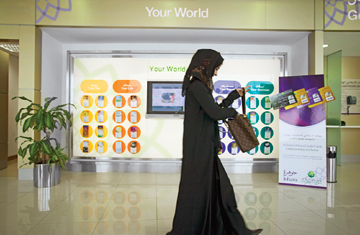
FAIR TRADE: Only female staff and customers are allowed in this branch of the Dubai Islamic Bank
The women's branches of the Dubai Islamic Bank feel more like spas than financial institutions. Clients at one branch in suburban Dubai lounge on sofas, flicking through magazines, nibbling dates and sipping coffee served from golden pots. Women from the Gulf wearing head-to-toe abayas sit beside Levantine businesswomen and Chinese expats in miniskirts. The tellers, bankers and wealth managers, like their clientele, are all female.
In Saudi Arabia, there have been female-only banks for decades — a reflection partly of Saudi women's wealth, partly of conservative attitudes toward them as precious creatures who need to be protected. But the past few years have seen women's banks and investment companies proliferate across the Middle East. Arab women, increasingly well educated and common in the workplace, are seeking financial independence. In the Gulf, flush with wealth from the oil and gas boom, they are looking to invest in more sophisticated vehicles than the traditional stashes for women's assets: banks and property. The Kuwait Stock Exchange has a women's floor; during the Arab stock boom of 2006, women in Dubai lobbied for their own corner on the stock exchange, complete with snacks and coffee service. And Saudi women now day-trade online in growing numbers. "Women are becoming more empowered in dealing with their wealth," says Shamsa Noor Ali Rashid, a board member of FORSA, a fund started by Dubai World last year exclusively for female investors.
As a result, bankers and money managers — not traditionally associated with feminist causes — are helping to power the region's slow-burn gender revolution. Investment firms like Merrill Lynch and private banks like the Swiss firm Clariden Leu have targeted Gulf millionairesses, some flying advisers out for teach-ins. Arab banks have also homed in on working women, issuing them credit cards and loans for cars and apartments.
This all dovetails neatly with regional mantras about the need to empower women. "Middle Eastern society has come to terms with the fact that in order to develop, it has to walk the talk of liberalism," says Florence Eid, a Middle East partner at American hedge fund company Pantera Capital Management. Of course, the finance industry is driven by commercial imperatives, not social ones. "This is not about women's liberation," says Graham Bell, managing director of Bridge Partners, a wealth-management firm in Dubai. "It's about money."
A lot of it. The Middle East Economic Digest estimates that Gulf women control around $246 billion, projected to hit $385 billion by 2011. In Saudi Arabia, women own about a third of brokerage accounts and 40% of family-run firms, albeit often as silent partners. A 2007 study by the International Finance Corporation, an arm of the World Bank, found that a third of women-owned enterprises in the United Arab Emirates generated over $100,000 a year, versus only 13% of American women-owned firms. Yet few Arab businesswomen could raise capital from banks, usually turning to friends and family instead.
Far from being the pampered, disenfranchised creatures of media legend, Arab women are increasingly savvy about finance. Last year, a Barclays Wealth survey found that Arab women are the world's most confident about investing in funds, and the most secure in their knowledge of estate and retirement planning.
High-profile women investment bankers like Nahed Taher, head of Gulf One Investment Bank, and Global Investment House's Maha al-Ghunaim, provide inspiration. Eid estimates that when she attended the American University of Beirut in the mid-1980s, about 15% of finance students were female; when she returned to teach in 2000, she says, over half were women. Others simply school themselves. When Khalida Mirza started selling marble, she had a high school education and four kids, but she quickly taught herself business basics through books and magazines. Today, she has a property firm and gives women jargon-free investment advice.