

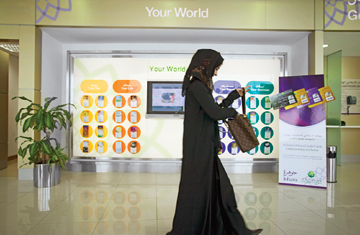
FAIR TRADE: Only female staff and customers are allowed in this branch of the Dubai Islamic Bank
(2 of 2)
The Arab woman investor has a long history. The Prophet Muhammad met his first wife, a wealthy Meccan trader, when she hired him to take caravans to Syria. When the Gulf's economy relied on pearls and fish, not gas and oil, absent men often left women in charge of their business affairs. Today, many Gulf women have lots of liquid assets, partly because of Muslim inheritance law. Shari'a dictates that a married woman's wealth is her own; spending on her household is her husband's responsibility.
For investment firms, the biggest prize lies in Saudi Arabia, whose women have an estimated $11 billion sitting in bank accounts. But the Kingdom's strict laws on gender segregation mean the obstacles are greater there, too. One wealth manager recalls sitting in a Saudi palace giving an investment seminar, all the while worrying about whether he'd be arrested by the mutawwa, or religious police, for being alone in a room with 40 women. Gulf conservatives may rail against women driving, showing their hair or voting, but opposition to women investors has been muted. "You don't see [extremists] worrying about women investing," says Rola Dashti, the first woman elected as chair of the Kuwait Economic Society.
Still, there's no question that becoming financially sophisticated brings a new level of independence. Bridge Partners, which includes Gulf royals and business billionaires among its clients, began focusing on managing money for women two years ago when a Saudi princess asked the firm to organize some investment workshops. Managing director Bell says he found "a lot of anger and frustration" among the workshop participants. "They'd say, 'I inherited this money from my dad, and it's just sitting there. We're not given the ability to make proper investments, to control our own money, or to run our own businesses.' They had lots of money, but no one to give them advice, except relatives. And your father or brother might be honest, but a stupid investor. Or he might be a great investor, but a jerk."
One way financial companies are reaching out to this lucrative demographic is by employing more women. Bridge Partners is launching the Ladies Investment House to target Saudi women. Female finance graduates will be trained as independent financial advisers, working out of their own homes to sell Bridge funds on commission. "They can sit at home on the Internet, or invite their rich girlfriends over for coffee, and help them invest," says Bell. "It's going to create wealth, and it's going to create jobs for Saudi women."
In tapping into this market, it clearly pays to be sensitive to the social and cultural dynamics of the region. But ultimately the key, as with male clients, is to offer financially compelling products. When an investment firm recently asked Dashti how to market its services to women, the meeting was short: "Go back to the ABCs of business," she said. "If you have a good product, women will buy it."
— With reporting by Shadiah Abdullah / Dubai