

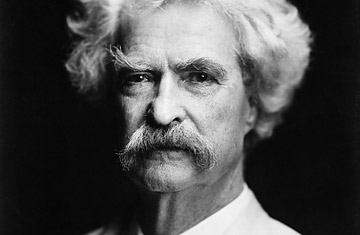
Samuel Langhorne Clemens, a.k.a. Mark Twain, pictured here circa 1900
(3 of 3)
Shortly after becoming President, Roosevelt made news by declaring, out of the blue, that "In God We Trust" should be removed from U.S. coins because they "carried the name of God into improper places." Twain responded, in conversation with Carnegie, that "In God We Trust" was a fine motto, "simple, direct, gracefully phrased; it always sounds well--In God We Trust. I don't believe it would sound any better if it were true."
Religiosity prevailed in Twain's era but not in his heart. Though one of his closest friends, Joseph Twichell, was a minister, Twain derided religions--Christianity, in particular--and the notion of a benevolent deity. His strongest written sacrileges were not published, however, until well after his death. He was a more interesting disbeliever in some ways than today's Bill Maher or Sam Harris or Christopher Hitchens, who readily dismiss religion as inflammatory nonsense. Twain, who was full of inflammatory nonsense, could appreciate the indigenous blessednesses he encountered around the world. Stopping in Benares, India, "the sacredest of sacred cities," Twain discovered that "Hindoos" venerate flower-garlanded phallic stones with enormous gusto, which led him to muse on the durability of the impulse to believe. "Inasmuch as the life of religion is in the heart, not the head," he observed, religions are hardy. "Many a time we have gotten all ready for the funeral" of one faith or another, "and found it postponed again, on account of the weather or something."
What put Twain off about religion was its bossiness and its alignment with corrupt community values that people--those standing to profit--insisted on calling a higher power. The very expression "moral sense" made him curl his lip. He denounced his own conscience, which frowned upon his anarchic instincts, his love of enjoyment, and made him feel guilty and rebellious.
The pivotal moment in Huckleberry Finn is when Huck decides not to do what his conscience tells him is right, to turn in "Miss Watson's Jim" as a runaway slave. Instead, he decides to abide by his personal affection for Jim, although the upshot will be, according to all he has been taught, eternal damnation for violating the norms of society and its view that a slave is the rightful property of its owner.
As Twain became increasingly angry over the years, less the jester and more the Jeremiah, there was grumbling in some quarters that he had been better when he was funnier. (You could call this the Woody Allen problem.) The New York Times accused him of "tumbling in among us from the clouds of exile and discarding the grin of the funny man for the sour visage of the austere moralist."
The Times had a point. As a social critic, Twain was most enjoyable when he followed his natural humorous tendency to denounce folly and iniquity in all directions. This is what he was doing in Following the Equator when he wrote, "All the territorial possessions of all the political establishments in the earth--including America, of course--consist of pilferings from other people's wash. No tribe, however insignificant, and no nation, howsoever mighty, occupies a foot of land that was not stolen. When the English, the French, and the Spaniards reached America, the Indian tribes had been raiding each other's territorial clothes-lines for ages, and every acre of ground in the continent had been stolen and restolen 500 times."
Try rallying a cause with that. Then there's the long essay Twain produced in 1901, "The United States of Lyncherdom." This is not a single-minded polemic. It registers the horror of lynchings but also undertakes to empathize with people who attended them. Their motivation, Twain argued, is not inhuman viciousness but "man's commonest weakness, his aversion to being unpleasantly conspicuous, pointed at, shunned, as being on the unpopular side. Its other name is Moral Cowardice, and is the commanding feature of the make-up of 9,999 men in the 10,000 ..."
As a remedy, Twain proposed, tongue in cheek, that sheriffs might be dispatched to communities where a lynching was about to take place. If they could rally enough citizens to oppose the hideous deed, that would make the anti-lynching position the new conventional wisdom that everyone would flock to conform to. But a problem--where to find enough sheriffs? Why not draft them from among the Christian missionaries spreading the malady of Western civilization in China? (Missionaries were a favorite target for Twain.) In China, he told his readers, "almost every convert runs a risk of catching our civilization ... We ought to think twice before we encourage a risk like that; for, once civilized, China can never be uncivilized again ... O compassionate missionary, leave China! come home and convert these Christians!"
There is something upsetting, off-balancing, about "The United States of Lyncherdom" that has kept it alive all these years. It's against lynching, all right, but it seems to take more of an interest in being against righteousness. It makes you wonder whether you yourself, possibly, or let's say your grandmother, might have appeared, smiling, in a photograph of a lynch mob. And just as you're about to block out that queasiness, Twain slams in a snippet of what a particularly despicable lynching (in Texas, as it happened) was like. Oh, God. (The man was slow-roasted to death over a coal-oil fire.) And then, when he starts taking off on the missionaries? I don't know that I want to express this opinion. But there's no getting around it: it's funny.
Not only was "The United States of Lyncherdom" politically incorrect, it still is. It blames one of the most shameful aspects of American history on moral correctness, the herd mentality that prevailed among Americans who regarded themselves as right thinking. Twain decided that the country, or at least his readership, was not ready for that essay. It wasn't published until 1923, when Twain's literary executor slipped it, hedgily edited, into a posthumous collection. Not until 2000 did it appear in its original form, and then in an obscure, scholarly publication. It takes a genius to strike the funny bone in a way that can still smart nearly 100 years later. The nation's highest official accolade for comedy is the Kennedy Center's Mark Twain Prize for American Humor, which will be awarded this November to the late George Carlin--another man whose commentary grew bleaker and more biting in his last years. But old Mark, unvarnished, might be too hot for cable, even, today.
Blount has written introductions for six editions of Twain's work. His next book, Alphabet Juice, will be published in October by Farrar, Straus & Giroux
America's Favorite Funnyman For more photos of Mark Twain, go to time.com/twain