

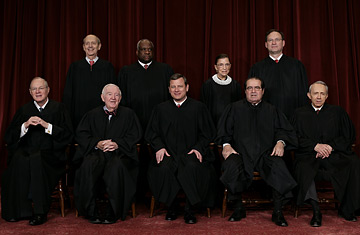
Justices of the Supreme Court of the United States
(2 of 2)
How long will the changed mood last? The role of personality on the Supreme Court shouldn't be overstated. In cases in which they have strong, pre-existing constitutional views on issues from abortion to guns to Guantánamo, the Justices are unlikely to persuade one another. And as Scalia said, "What changes the court, I assure you, is much less the character of the Chief Justice--although that has some effect--than it is the nature of the people who have been appointed." That's why, regardless of Roberts' current consensus-building, the future of the court will be determined by the next presidential election. If McCain wins and gets to replace one or two liberal Justices with reliable conservatives, there will be a lopsided conservative majority and Roberts will have little incentive to win over the marginalized liberal Justices who remain.
By contrast, if Obama wins, the ideological makeup of the court will remain the same for the foreseeable future--four liberals and four conservatives, with Kennedy in the middle. In that case, Roberts' success in promoting bipartisan unity may make the difference between a Supreme Court that declares war on Obama's domestic agenda--from health-care reform to a national response to global warming--and a court that is content to get out of the way of a Democratic President and Congress. Maybe that's why Obama is already sending bouquets to the Roberts Court: even if the Chief Justice isn't his new best friend, Obama may soon need him more than ever.
Rosen, a law professor at George Washington University, is author of The Supreme Court: The Personalities and Rivalries That Defined America