

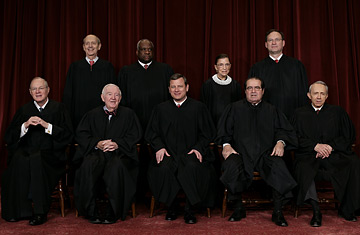
Justices of the Supreme Court of the United States
The biggest surprise from the Supreme Court term that just ended: Barack Obama hearts the Roberts Court. At the end of June, the Democratic candidate praised Justice Antonin Scalia's 5-4 decision striking down the Washington ban on handgun possession, a ruling that recognizes the right to bear arms as an individual right. Two weeks earlier, from the other side of the ideological spectrum, Obama praised Justice Anthony Kennedy's 5-4 decision allowing enemy combatants to challenge their detentions in federal courts, a rebuke to the Bush Administration's policies toward Guantánamo detainees. Obama's only major quarrel with the court was the 5-4 decision banning the execution of people who rape children: he said he has long believed that "the most egregious of crimes" deserve the death penalty. When a leading Democrat is criticizing the Supreme Court for not being conservative enough, it's time for liberals to breathe a sigh of relief.
It's true that there may be some election-year pandering in Obama's embrace of a court that many predicted would veer to the right under Chief Justice John Roberts. But by any measure, the term that just ended was hardly a disaster for liberals. On the contrary, liberals won several important victories--not only the Guantánamo and child-rape cases but also a series of employment-discrimination cases in which the court sided with workers rather than employers, by broad, bipartisan majorities.
Indeed, the court's term was something of a group hug between the liberal and conservative Justices. The Supremes were far less divided than they seemed last year, when they sniped at one another in unusually personal terms. Despite some high-profile splits at the end, only 17% of the cases were decided by 5-4 votes--down sharply from the previous term, in which 33% of the cases were 5-4 splits. Cases upholding voter-ID requirements, execution by lethal injection, federal efforts to curb child pornography, and the detention of American citizens in Iraq were decided unanimously or by lopsided majorities.
So, what explains the new mood of bipartisan harmony on the Roberts Court? At least some of the credit goes to Roberts' personality and leadership style. He went out of his way to persuade his colleagues to turn down the volume and lighten up when they disagreed, even spicing up his dissent in a technical dispute between phone companies by borrowing playfully from Bob Dylan's Like a Rolling Stone: "When you got nothing, you got nothing to lose."
According to Scalia, Roberts has used his power to assign opinions when he's in the majority to encourage his colleagues to write narrow decisions that Justices on both sides can accept. "The chief may say, 'Why don't you come along with a very narrow opinion? We can get seven votes for that, and it will look a lot better,'" Scalia recently said on The Charlie Rose Show. "You want to go along with the Chief Justice because ... you want to make the institution work. So he has."
This, as it happens, is precisely what Roberts promised to do at the beginning of his tenure. In July 2006, Roberts told me and other journalists that he was worried about "the personalization of judicial politics," whereby people identify the rule of law with the way individual Justices vote in closely divided cases. Embracing as a model his greatest predecessor, John Marshall, Roberts said he would use his power to assign majority opinions to promote narrow decisions agreed to by wide, bipartisan majorities rather than by polarizing 5-4 splits. On an evenly divided court, Roberts felt he could convince the liberal and conservative camps that converging on narrow opinions was in everyone's interest.
During his first term, which ended in 2006, Roberts managed to avoid 5-4 splits--for the most part, he said, because his colleagues were eager to be nice to the newcomer, like prospective in-laws meeting a fiancé for the first time at Thanksgiving. Then the honeymoon ended. When various Justices were asked last year whether they thought Roberts could rebuild an atmosphere of bipartisan harmony, they were hardly encouraging. Scalia scoffed, "Good luck!" Justice Stephen Breyer suggested Roberts could best foster comity by joining Breyer's opinions. Kennedy had a similar response: "Just let me write all the opinions!"
And yet, in his third term, Roberts has achieved what his colleagues had thought was nearly impossible. His success is a reminder of the importance of personality when it comes to leadership on the Supreme Court, in which the quirks and temperaments of individual Justices are as important as judicial philosophy in shaping the law. Roberts told me that he thought much of Marshall's success was due to the fact that his colleagues liked and trusted him. Marshall persuaded the Justices, at the beginning of the 19th century, to live in the same boarding house and discuss cases over glasses of his excellent Madeira. (Once, in an unfortunate burst of temperance, when the Justices voted to drink only when it rained, Marshall looked out the window and noted, "Such is the broad extent of our jurisdiction that by the doctrine of chances it must be raining somewhere.")
Roberts' success is also a reminder of the Chief Justice's limited but real power: as the Justice who speaks first at the court's private conference, he can frame the issues and influence the kinds of cases that the court agrees to hear in the first place. Under Roberts' leadership, the court has agreed to hear fewer polarizing constitutional cases and more cases of interest to business, which the Justices are more inclined to resolve without dividing along ideological lines. Of the 15 cases in which the U.S. Chamber of Commerce filed briefs this year, 80% were decided by 7-2 or higher, and a third were unanimous. Roberts told me that he thinks that bipartisan agreement in the less visible business cases can help develop a "culture and an ethos that says, 'It's good when we're all together.'" A sign of Roberts' success in putting his stamp on the court: he was in the majority in 90% of the cases this term, more frequently than any other Justice.