

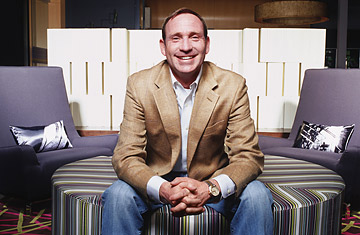
Brian McGuinness in Aloft's lobby
You've just spent 12 hours on the torture rack of business travel and are heading for your hotel. What kind of experience do you want beyond the entryway? A doorman leading you into a shiny, marble lobby, with Muzak gently playing in the background (and a hand out for a tip)? Or would you rather enter a scene out of Friends, with comfortable couches, Nina Simone on the sound track and a game of pool going on? If you desire the latter, you're probably under 35, or perhaps you just think like someone who is.
And hoteliers such as Starwood's Brian McGuinness are on to you. Pulling up to a warehouse in an anonymous Hawthorne, N.Y., industrial park, McGuinness, head of Starwood's new line of hotels, Aloft, is eager to show off the full-scale model of the group's newest brand, a 136-room hotel with an average rate of $150 per night. Leading the way, McGuinness stops before a brightly lit entrance. A waterfall cascades down a wall, replete with the soothing sounds of a babbling brook, "to wash away troubles," he explains as he passes through the second set of doors leading to the check-in kiosks. "Our customers find this sometimes more convenient than waiting in line at the desk," says McGuinness as he taps on the screen to demonstrate how you can select the location of your room. The actual check-in desk, called the Aloha desk, to the left, is circular--there's no imposing, long granite counter. "We wanted to put the desk staff in the middle of the room," McGuinness says as he backs up against the nearest wall. "Who stands against the wall at a party? Wallflowers!"
Party on, traveler. The company that started the industry's bedding wars is looking to define a new segment called "lifestyle" hotels: chic, sociable and affordable. The first Aloft outpost opened in Montreal in June, and a further 17 openings are planned this year. Aloft is focused on attracting the road warrior, a customer who has grown up with the irreverent, friendly service of Southwest Airlines, the open office, the work-among-the-crowd Starbucks culture, and is accustomed to innovative design, via Target and Ikea, at a good price. The next generation of business travelers may have meetings with Wal-Mart in Bentonville, Ark., but they don't want to be separated from their hip, urban social lifestyle.
And they won't have to, since the competition is revving up new hotel designs too. Hotel Indigo, which InterContinental Hotel Group launched in 2004, is rolling out in Miami, St. Louis, Mo., and 12 other locations. NYLO, created in part by an executive from Starwood's W, hopes to trade on Manhattan coolness. Even familiar faces like Wyndham, Hyatt, Marriott's Courtyard and Hilton's Garden Inn are getting wired for Gen Y.
Like the changing focal point of the home--the combined kitchen/family room where everyone now hangs out--the Gen Y customer wants a similar seamless experience on the road. That's a big change from boomers, who wanted to be rewarded for traveling. They expected a hotel that was nicer than their home, which Fairmont, Four Seasons and Ritz-Carlton have provided since the '80s. According to Y Partnership, this next generation of travelers wants casual food available anytime, free Internet, views and self-service check-in/checkout. Gen Y may represent only 9% of business travelers at the moment, but it is 75 million strong. Change is coming. Fast. "The baby boomers are the segment that everyone has been chasing for the past 20 years," says Peter Yesawich, chairman of Y Partnership, who also consults for NYLO. "Gen Y is a market of comparable size. There's a big 'aha' when hotels discover that." The Gen X travelers, in their 30s, are also important. They earn on average $6,000 per capita less than boomers but travel more and spend more per capita on travel, according to Bjorn Hanson, chief lodging analyst at PricewaterhouseCoopers. "If you were designing a new concept, it would be logical to appeal to the high-propensity consumer."
These new travelers are far more adventurous, far more curious and far more tech-focused than their parents. "They're interested in things that are a lot less traditional, things that have much greater personality and the experiences that are a little less predictable," says Yesawich, "which is why design has become the primary basis of differentiation for these lifestyle hotels. They don't want stuff that looks like it was all shipped out of the same warehouse in North Carolina."
NYLO, a partnership between five executives at other brands, including W, and funded in part by Lehman Brothers' private-equity arm, has latched onto the same multiuse lobby, designed to encourage guests to socialize and kitted out with cool features like wi-fi, chairs that hang from the ceiling and a Nintendo Wii. Offering 135-to-200-room hotels that cost an average of $120 to $200 per night and an upcoming brand, XP, at the $95-to-$110-per-night level, NYLO opened its first hotel in Plano, Texas, a suburb of Dallas, and expects 50 more to open or be in contract by 2010, including one in Broomfield, Colo., for travelers visiting Colorado's tech corridor.
Both Aloft and NYLO hope to attract locals to the lobbies and thus appeal to the new traveler's desire to experience regional flavor while moving around the country. NYLO not only has design features that play up the locality, like cowhide rugs and glass chandeliers in the shape of antlers in Texas, but, like Aloft, also will offer local entertainment such as bands, art shows and movie nights, along with staff members who may be desk clerks by day but are dancers, writers and artists by night.
Localization as opposed to standardization is a common theme. InterContinental's Hotel Indigo is so locality-focused that each city's hotel has an entirely different décor and sponsors local art auctions and singer-songwriters in the lobby. There are guitars for guests to play hung on the wall in Nashville and a dog named Indie residing in the Atlanta hotel. Indie is hosting canine cocktail parties this summer. "We've got the element of surprise of a boutique," says Jim Anhut, head of franchise development at InterContinental Hotels, "with the conveniences of a big brand."
To design its 15 hotels and the 12 more coming this year, Anhut says the company looked to retailers such as Barnes & Noble, Starbucks and Nordstrom rather than demographics for inspiration and used retail-store designers to create some of the spaces. Anhut, like McGuinness, talks about a hotel that provides an experience--notes to guests are written in haiku, and the staff comes from behind the desks to help with luggage or discuss the best local restaurants. "Their customer is maybe a little more conservative than Aloft," says Chris Woronka, an analyst who follows the hotel industry for Deutsche Bank, "but hipper than Marriott Courtyard or Hilton Garden Inn customers."