

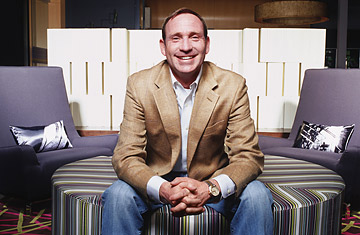
Brian McGuinness in Aloft's lobby
(2 of 2)
Eventually, travelers do want to sleep. And the new brands Aloft and NYLO are introducing some innovations, the most radical of which is the orientation of Aloft's bed, which faces the windows rather than the dresser. McGuinness says the idea stems from guests who are always requesting rooms with a view. But an industry analyst wonders if there isn't perhaps a more practical reason. With about a third of upscale franchisees switching brands at some point, according to Smith Travel Research, Aloft franchise owners may have a hard time converting their hotels to Marriotts, where beds are oriented toward the dresser.
With little in the way of furniture, hotels of both brands have reallocated money ordinarily spent on bureaus and armoires--where traditional hotels hide the TVs--toward spalike bathrooms and custom mattresses. Flat-screen TVs duplicate home-entertainment centers--guests can hook up their laptop or iPod to watch movies or rehearse PowerPoint presentations. High ceilings and oversize windows in the 275-to-325-sq.-ft. Aloft rooms make the room feel more spacious. NYLO's rooms have brick walls and concrete floors to create an urban-loft experience--and reduce cleaning costs.
Marriott's Courtyard and Hilton's Garden Inn, currently the leaders in the upscale sector, don't plan on letting these trends pass them by. Marriott redesigned the lobby of its Fair Oaks, Va., location with a bar, communal-seating areas and a snack area. "It used to be that guests went in the room and latched the door," says Brian King of Courtyard. "Now they want to come out." The new design will be rolled out at most of the 700 locations by 2010. Like Aloft, Marriott is also eliminating the long, chest-high check-in desk, replacing it with pods that will allow clerks to step out and interact with guests.
But Marriott is determined not to lose the boomers. "Our motto is 'You dance with the one that brung you,'" King says. So the furniture--while contemporary, warm and approachable--is deliberately not hip, although the lobby is color coded for coolness: blue for technology, including chairs and tables with accessible plugs; orange for food. According to Marriott, the new lobby has been so successful, the Fair Oaks hotel owner has seen his first-quarter revenue per available room, a standard industry-profitability measurement, rise 12% over last year's.
With the economy wobbling, everyone in the hotel industry is battling for customers. Smith Travel Research forecasts growth of just 4.4% in room rates over last year. The upscale sector, in which Aloft competes, is currently worth about $12.5 billion. Woronka says profits for this sector are usually about 15% for owners, and expects that Aloft's owners will be earning about the same. According to Starwood, an Aloft hotel costs from $17 million to $25 million for a developer to build, not including land, which could be a little higher than the cost of a Marriott Courtyard or Hilton Garden Inn, Woronka estimates. The key difference for developers may be that being new, Aloft has more wow factor. "You can renovate the older brands all you want," says Woronka, "but Aloft has a different feel." And that's good news for Starwood, which until now has not had a hotel brand in this segment, accounting for 11% of the hotel industry's revenue.
In a business in which everyone is basically offering the same thing--a bed for the night for a price--who might win the new hotel consumer? Jan Freitag, an analyst at Smith Travel Research, says what customers still care about most is location. In that sense, Marriott and Hilton have the advantage. But don't count anyone out. "Starwood, with its W hotels, has shown there's a desire for a hotel that's edgy and hip," says Freitag. "Hilton and Marriott have shown that you can have a family of brands without diluting the name."
Freitag thinks there's a pent-up demand for these hotels. When Starwood introduced the Westin Heavenly Bed, he says, "everyone thought it was, if not crazy, then highly unorthodox. Now name any brand, unless you're low-end economy; they all have deluxe beds." Starwood countered with the Heavenly Bath, and the industry followed. This time, says Freitag, "other brands aren't about to let Starwood get out in front."
But one analyst thinks perhaps some companies have read a little too much market research and forgotten why people like hotels. "They can be inclusive and have casual design," says the analyst, who asked not to be named, "and still offer a reward in travel--like traditional pampering. That's probably going to have to be added to a few of these concepts." Freitag says it will be interesting to see how well Aloft and others can penetrate a segment that Hilton and Marriott currently own. "Will they win a piece? Yes. But how big?" says Freitag. "That's the $12 billion--dollar question. The traveler is going to have to decide."