

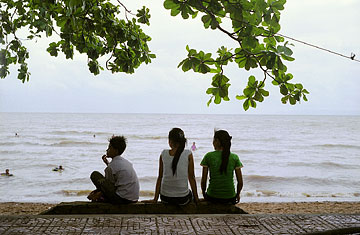
Beach in Kep
(2 of 2)
Paradise or Vassal State?
A few hours drive down the coastal road, I was sitting inside the dusty office of Sokun Travel and Tours when the lights cut out. "No good," said the woman behind the desk, looking into the dark street. "Every day, two or three times." We conducted the rest of our transaction by candlelight. Mourn Sokun, who owns the travel agency, says Sihanoukville, the current hub of south-coast tourism, can't keep up with the rush of tourists. The number of foreign visitors to the city shot up by 50% between 2006 and 2007, and infrastructure, including electricity generation, is overtaxed. In 2007, the local airport reopened to shuttle tourists between Angkor Wat and the coast, only to close months later when a domestic flight went down, killing 22 people on board. It's still closed today. Som Chenda, Sihanoukville's minister of tourism, says the city needs more of everything — more hotel rooms, more restaurants, more hospitality training, more language teachers. "We need it all," says Som. Right now, Sihanoukville doesn't even have enough fresh produce coming in: "There are too many tourists and not enough food."
In a line of work that relies on clean beaches and clear water, Mourn, the travel agent, worries the authorities aren't working hard enough to protect the environment. As more guesthouses and bars pay their license fees to operate at the popular beaches, Mourn says raw sewage is being piped into the water and trash is being dumped onto the sand. "People pay their money, and the government closes their eyes," Mourn says. Government officials say they are aware of the growing problem. "The coast is not so good now because of the fast development," says Prak Visal, who heads the Sihanoukville branch of a regional coastal-management project. Solid-waste dumping, mangrove destruction, unsustainable fishing practices and illegal logging are a few of the challenges he says the area faces. But slowing things down? Not an option. "We protect, but we develop, too," Prak says.
Though some are happy with the money they've made, others living in valuable areas fear they'll lose their land, or lose it without being fairly compensated. Few families hold formal land titles, leaving many to rely on local authorities to vouch for them as landowners if a developer comes calling. Though efforts to provide documentation for landowners have been ramped up — almost 1 million land titles have been granted since 2004, according to the World Bank — there are millions more to go. Cambodians' scramble to secure their rights speaks to a fundamental anxiety: faith in the law is dismally low. For the past two years, the country has ranked near the bottom of Transparency International's Corruption Perception Index, and in a 2007 World Bank study, only 18% of respondents said they thought judges were honest. "Corruption is so pervasive it's part of the culture," says Theary Seng, executive director of the Center for Social Development, a Phnom Penh-based NGO. She worries that the billions coming in from private investment — particularly in oil — will not trickle down to the countryside where 80% of the nation lives. "If they want to do it right, they have lots of good models in the world," says Mussomeli, the U.S. ambassador, warning against Cambodia going the way of oil-cursed nations like Nigeria and Chad. "Or they could do it wrong and they could suffer the political consequences in 20 years. This is their chance to be a real country. This is their chance to have a real economy. If they screw it up, they'll be a vassal state."
The Road Ahead
Alongside road 4, the 143-mile (230 km) ribbon of asphalt connecting Sihanoukville and Phnom Penh, water buffalo graze in rice paddies that stretch from horizon to horizon. Kids in white school uniforms pedal their bikes in the dirt, moving alongside traffic like birds riding on air currents. It's places like these — in other words, most of Cambodia — where the five-star visions of the coast begin to get a bit blurry. Neither tourism nor oil alone can drive the national economy in a meaningful way. There must also be investment in agriculture and other sectors that employ most Cambodians, says Arjun Goswami, country director for the Asian Development Bank. "If one of these days I can go into Whole Foods and see a Cambodian export on the shelves, that's when I'll be a happy man," says Goswami.
In Phnom Penh, I stop by the offices of Rory and Melita Hunter, an Australian couple whose real estate company was recently granted a 99-year lease to build a luxury boutique hotel on Song Saa, a tiny pair of islands off the coast. They show me elaborate renderings of the future 40-room complex, replete with a wine cellar, air-conditioned library and 15 over-water bungalows designed to reflect the architecture of a nearby fishing village. The Hunters paid relocation costs for the 15 or so families living on the islands. They hauled away tons of trash that had been piling up for years, and started to revive the local coral reef that had been all but destroyed by overfishing. "Knowing that there had been all these other issues about how people had been relocated, we wanted to do it properly from the start," says Rory Hunter. "We're going to be doing business here for a long time." Maybe money will buy happiness for Cambodia; maybe it won't. But nobody said paradise was built in a day.