

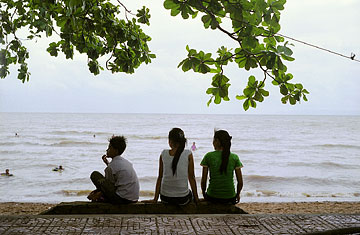
Beach in Kep
Whoever says money can't buy happiness hasn't shelled out for their own beach in Cambodia. Before the crew of the Sea Breeze can even drop her anchor, Alexis de Suremain is in the water, swimming straight for 90 yards of white sand: his 90 yards of white sand. A wall of tangled jungle rises to the east; to the west, the sun sinks into its own reflection over the Gulf of Thailand. "See that?" de Suremain asks, waving at the sun as it bisects the beach view. "Right down the middle."
If all goes according to plan, these 35 acres (14 hectares) of sand, rock and jungle will in a few years host a plush eco-resort of palm trees and solar-powered bungalows. De Suremain, a French expat who runs guesthouses in Phnom Penh, says he combed Cambodia's shores for three years before he settled on building his resort on the remote island of Koh Rong. "I wanted something where you couldn't hear karaoke, where the neighbor's dogs don't bark and where the cocks aren't crowing in the morning," he says. "I wanted something completely isolated."
He's got it — for now. The postcard-perfect beaches of Cambodia's scores of islands and 270 miles (435 km) of southern shore have gone largely unnoticed by developers for the past 40 years. But in 2007, a record 2 million tourists visited Cambodia, signaling that the country was beginning to shake its killing fields image as an impoverished backwater where wandering off the beaten path could mean finding yourself astride an unexploded land mine. Cambodia is starting to register as a must-see destination, and it's not all about Angkor Wat. Brackish mangrove swamps and remote beaches are being envisaged as golf courses and plots for five-star bungalows with private pools. Indeed, there are signs of vitality in other sectors of the impoverished country's once moribund economy. Cambodia's GDP grew 10.4% in 2006 — the highest rate in Southeast Asia that year — and foreign investment shot up some 400% to nearly $4 billion. Thirteen foreign companies, including Chevron, have licenses to explore Cambodia's offshore blocks for oil and natural gas; the government says domestic oil production could begin within three years. The rush for Cambodia's gold coast is on, raising hopes that the economic torpor of this aid-supported nation will finally end. "This part of the country has been a revelation for me," says Steve Smith, a Londoner who finances his endless summer as a dive instructor in southeast Asia. "I didn't even know there were beaches in Cambodia."
The Undiscovered Country
To witness this awakening up close, I recently borrowed a wreck of a bicycle for a slow ride through the sleepy Cambodian seaside town of Kep, near the Vietnamese border. After limping along the potholed coastal road past unkempt plots of oceanfront land with crumbling colonial-era manses, I stopped to look at a billboard — the only one in sight. On it was a picture of a home that would not have looked out of place in a Denver subdivision. A young man pulled up on a motorbike next to me. "You want to buy?" he asked. I told him I wasn't in the market, and so he handed me a flyer for his business, Sunny Tours, that bore a stern warning: NOW IS THE TIME TO ENJOY KEP!!
Five years ago, Sunny Tours' catch-it-while-you-can marketing wouldn't have been very effective. In the early 20th century, Kep-sur-Mer was established as a getaway for French civil servants running the colony, and it served as an enclave for rich Khmer after independence in 1953. (The former King, Norodom Sihanouk, built a royal residence there that, like most of the old estates in town, now stands empty.) The holidays ended in the 1970s after an American bombing campaign brought the first wave of more than two decades of war, including the Khmer Rouge-led genocide that killed nearly 2 million Cambodians between 1975 and 1979.
Stability has been slow to return to Kep and to the country as a whole. But today nearly every Asian nation has a stake in Cambodian industries, from hydroelectric dams to oil exploration to real estate development. In Kep, three Modernist homes have been restored into Knai Bang Chatt, a striking boutique hotel owned by two Belgians. At the other end of town, the early 20th century La Villa de Monsieur Thomas is being revamped into a five-star resort by a Khmer developer. And in February, Sokimex, a powerful Cambodian company that imports most of the nation's petroleum, began converting a colonial casino on Bokor Mountain into a flashy new resort. "All of a sudden there's interest," says Joseph Mussomeli, the U.S. ambassador to Cambodia, who last year hosted the first American business conference in Phnom Penh. The country is "lucky to be stuck between 85 million Vietnamese and 65 million Thai," he says. "It's hard to ignore this place now."
More projects are in the works. About an hour's motorbike ride down a red dirt road that trails off the coastal highway, residents of the fishing village of Angkoal have started selling their small holdings to real estate developers. One family, residents of a palm-fringed knob of land that slopes into the water, says their property is regularly visited by speculators. "They come every day," says Sry Mau — even though the place where the young woman's family has lived for 23 years has already been purchased by a Cambodian hotelier for $8,000. With the money, they bought a new, considerably smaller piece of land across the road and a new fishing boat.
In a country where 4.7 million people live on less than 50 cents a day, the surge of investment is changing lives and could help create jobs. The country desperately needs more employment opportunities. About a third of Cambodians are 15 years old or younger, and they'll be entering the workforce in droves over the next two decades. Hundreds of NGOs are already busy trying to fix Cambodia, and about 20% of the government's total budget still comes from foreign aid. The prospect of a tourism boom coupled with the start of domestic oil production offers the tantalizing possibility of a more independent way forward. With foreign aid, "you'll always be living according to somebody else's rules," says Rithivit Tep, director of the private-equity firm that owns Kep's Thomas villa and development rights to two islands. "We have wasted a lot of time."