

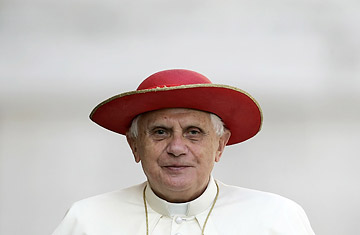
This will be Pope Benedict XVI's sixth trip to the U.S. and his first as Pontiff.
(3 of 3)
Reason is a word that surfaces repeatedly in conversations about the Pope and the U.S. Benedict's critics regularly accuse him of Vatican II revisionism--of downplaying the idea that Catholics may legitimately balance church teaching against the demands of their conscience. More broadly, they accuse him of minimizing the degree to which the Holy Spirit led the council to make substantial changes in the faith. But he remains true to the Vatican II precept of complementing blind piety that prevailed in the church before the 1960s with the rationalism of the Enlightenment and thus with modernity.
He is hardly the first: John Paul II described faith and reason as the twin wings that lift the church. And yet a balanced takeoff has remained elusive. The U.S. is one of the few places where it seems to happen regularly. "America is simultaneously a completely modern and a profoundly religious place. In the world, it is unique in this," says a senior Vatican official. "And Ratzinger wants to understand how those two aspects can coexist." Almost all the things the Pope likes about us--our faith in the real value of plainspokenness, our pluralistic piety and even our wrangles around applying religiously grounded moral principles to increasingly abstruse science--can be understood in light of this quest. If he finds answers in the U.S., they could help define his papacy.
When he arrives on U.S. soil on April 15, we in the press will no doubt be parsing Benedict's every sentence for his opinions on U.S. policy or remonstrance of American morals. But the most important waves emanating from this contact may reverberate well beyond tomorrow's news cycle. John Paul II and the U.S. played as anticommunist co-leads on the 20th century stage. This Pope, more a student of global drama than an eager protagonist, knows that rising religious conflict may be the 21st century's great challenge. He also appears to sense that American power alone won't solve it--but that the power of American values still might. In rummaging through our founding precepts for a path for his own purposes, he might find something important for us to remember too.