

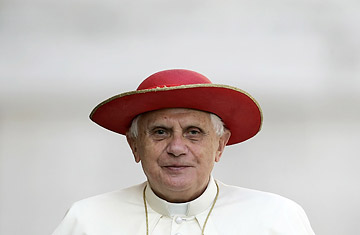
This will be Pope Benedict XVI's sixth trip to the U.S. and his first as Pontiff.
(2 of 3)
But he also came to respect the way Catholic leaders in the U.S. went about their business. A current (non-American) CDF official notes that the U.S. church is the only one that keeps a "serious" doctrinal office rather than an unthinking rubber stamp or an old-boys' club; when conflicts arise, its bishops are actually prepared to discuss them. Moreover, says Levada, "he seems to recognize that we're plain speakers. We don't hide behind words."
The Pope also admires the Americans' role as, in the words of one cleric, "intellectual first responders," especially as the country's great network of Catholic hospitals wrestles with novel problems of medical ethics. "Through the great sphere of worldly experience that the Church has in America," Benedict wrote, "as well as through her faith experience, decisive influences can be passed on." He has shown his comfort with the direct and thoroughly American approach by appointing Americans to the No. 1 and No. 3 spots in his powerful former office.
The most rapt expression of the Pope's enthusiasm for the U.S. came in a high-minded 2004 dialogue with the president of the Italian Senate, Marcello Pera, published as the book Without Roots. It bemoans the European Union's refusal to acknowledge Christianity in a draft constitution, and Pera wonders about bringing back some kind of multidenominational "Christian civil religion." In response, Ratzinger cites Alexis de Tocqueville's Democracy in America and makes the case that America's Founding Fathers were pious men of different denominations who wrote the First Amendment prohibiting state establishment (that is, sponsorship) of religion precisely because sponsorship would stifle all non-established creeds--which they hoped would achieve full and varied flower.
Of course, no such bloom would occur if the American soil were not already faith-saturated. But Ratzinger believes in America's "obvious spiritual foundation," its natural, Puritan-instilled DNA. He is well aware that this is eroding; he thinks we watch too much TV and fears that American secularization is proceeding at an "accelerated pace." But he insists that there is a "much clearer and implicit sense" in the U.S. than in Europe of a morality "bequeathed by Christianity." He has also given earnest thought to the mechanics of this civil religion, specifying that to affect the moral consensus, it is not enough for Catholics to rub shoulders with other Christians; they must translate their concerns from doctrinal language into a "public theology" accessible to all.
His American Flock
It may be that Benedict, who has sometimes seemed ready to trade a larger, lukewarm flock for a small, fervent one, is studying how to be small effectively. Says a church official whose thoughts usually reflect his boss's: "The American church has always had to live the minority experience, and that's where the universal church is headed." In fact, the American church has not really shrunk much. At 24% of the population, Catholics remain a pivotal voting bloc, especially in swing states like Pennsylvania, where they appear to favor Hillary Clinton by sizable margins. A recent poll by the Pew Forum on Religion & Public Life found that a quarter of the country's cradle Catholics had left the fold. But they are being replaced by a few converts and a lot of (Mass attending!) Hispanic immigrants, and remarkably, such churn is about par across the American religious landscape.
Although the Catholic priest shortage continues in the U.S., the priest-abuse scandals have not sparked a massive parishioner exodus. (Benedict is expected to address the topic on this trip, but there have been no leaks as to how.) Perhaps out of relief that he has been writing encyclicals about love and charity rather than heresy, U.S. Catholics seem to be treating him a lot like former Pontiffs: handing him a 70% approval rating while continuing to ignore church teaching on birth control and abortion.
In any case, Benedict often seems less interested in scolding American Catholics than in talking up "new religious communities ... being formed who quite consciously aim at a complete fulfillment of the demands of religious life." In the U.S., that could mean schools like Thomas Aquinas College in Santa Paula, Calif.; Christendom College in Front Royal, Va.; and Ave Maria University in Ave Maria, Fla. The numbers are tiny--the three colleges combined claim some 1,200 undergrads--but they are precisely the kind of eruptions of non-state-related religious vitality at which he thinks we excel.
There are times when Benedict's love affair with American religious pluralism seems a bit naive, especially when it clashes with his nonnegotiable doctrinal stands. Without Roots had wonderful things to say about Protestantism as the genius of American religiosity and burnished the alliance between Catholic conservatives and American Evangelicals against abortion. But in 2000 and more acidly in 2007 (after he became Pope), the Vatican released documents describing Protestant churches as suffering from ecclesiastical "defects," adding that "it is difficult to see how the title of 'Church' could possibly be attributed to them." Some of Benedict's new allies were a bit stunned.
When Benedict zings the Protestants or his proxies zap scientific atheists, he is actually engaging in cultural pluralism American-style, which resembles a political talk show more than a stately seminar on the Bill of Rights. The desire to keep talking while airing real differences may also be influencing his policy toward Islam (which, as the Vatican noted in March, has just replaced Catholicism as the world's most populous faith). After a startling 2006 speech in which he quoted a source calling Muhammad evil, prompting enraged extremists to burn churches and kill a nun in Somalia, Benedict entered into a dialogue with Islamic clerics who sent an open letter expressing a more conciliatory if sometimes critical response. None of the parties are departing from their theology, but out of frankness, a tenuous bridge seems to have been built.
This may hold some implicit lessons about how Benedict feels the U.S. and its allies should interact with Islam. The Pope has refused to accept pre-emptive war as just, and a confidant recalls him shaking his fists and shouting "Basta!"--Enough!--back in the early days of the Iraq war. He may be trying to model a clash of civilizations without bloodshed. As Roberto Fontolan, the Vatican-savvy spokesman of the lay group Communion and Liberation, puts it, "Let's not talk about dogma. Or whether my God is better than your God. Let's talk about reason that we both have as a gift from God. What does it tell us?"
Benedict's Quest