

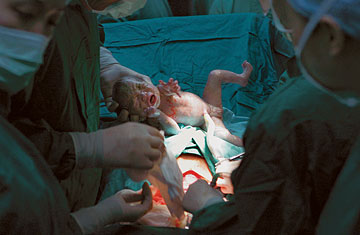
Slice of life: Despite the risks, large numbers of women are opting for C-sections to avoid birth pain and to control the date of their baby's arrival
(2 of 2)
An Unkind Cut
Cesareans are not without drawbacks however, and they begin the moment the last stitches are made in the stupefied patient's lower belly. The WHO recommends that babies be breastfed within an hour of birth, because vital antibodies and protective proteins — in effect, the baby's first immunizations — are delivered through those precious early drops of milk. But, as Dr. Atwood points out, breastfeeding "is difficult to do if you are coming out of anesthesia. That's a serious issue." Some women remain groggy for hours.
In the days following a C-section, a woman will be at an elevated risk of potentially fatal blood clots or infections. This is common to all major surgery, but means that more women die as a result of cesarean section than in natural childbirth. The U.S. figure of 12.1 maternal deaths per 100,000 births in 2003 becomes 36 if only cesareans are considered — and the difference, according to Obstetrics and Gynecology, is "attributable to the surgery itself, not any complications that might have led to the need for surgery."
Finally, as a woman contemplates future children, she may face the possibility of reduced fertility. A 2004 study found that women who had cesareans were almost four times more likely to have problems conceiving again, compared to women who gave birth naturally. The former will also experience increased risks of ectopic pregnancy and placenta previa or accreta (an abnormally located placenta, which may cause bleeding and other complications). And because many doctors will not permit a woman to undergo natural childbirth once she has had a cesarean — because the uterine scar may rupture during labor with potentially dire consequences — it is likely that her subsequent children will also be surgically delivered, multiplying all of these risk factors each time. "If there is no medical reason to have a C-section, we would advise [women] to have a vaginal delivery," says Professor Tan Kok Hian of KK Women's and Children's Hospital in Singapore.
Despite the procedure's pitfalls, there have been few official attempts to reduce Asia's high cesarean rates. One of the more notable instances was in South Korea in 2004 — three years after the country's rate hit an OECD high of 40.5%. A chastened government launched a campaign to encourage natural childbirth, and the number of prenatal classes was also increased, allowing more women to learn about the pain-management techniques essential in vaginal delivery. "Overall, Korean women are much more educated about the issue," says Kim Jae Sun, an official at the government's Health Insurance Review and Assessment Service. But she also admits that the campaign was underfunded and haphazard. While the country has seen a drop in the cesarean rate, it is not a dramatic one.
In Thailand, the pleas of natural-birth advocates do not find a large audience. "It's like pushing a stone uphill," says veteran campaigner Dr. Tanit Habanananda of the Childbirth and Breastfeeding Foundation of Thailand. "We're frustrated. It's very easy to get a C-section in Thailand. We have some colleagues at hospitals trying to change things but it's very hard." His spouse, Dr. Melanie Habanananda, adds: "If you use the term 'natural birth' here, people think it means you have to go sit in a paddy field to have your baby." Cesareans, she says, "have become very fashionable, especially among middle-class women" A third of the babies at Bangkok's private Samitivej Hospital, for instance, are delivered by C-sections, even though its birth unit was set up by Dr. Tanit Habanananda specifically to promote natural childbirth. (Those babies are also almost entirely born to Thai mothers. The foreign women who make up a large portion of Samitivej's admissions prefer to try for natural birth, says Dr Boonsaeng Wuttihpan, head of Samitivej's birth unit, who adds that the hospital remains very committed to promoting nonsurgical delivery.)
In general terms, the medical establishment comes in for a hard time from natural-childbirth advocates, many of whom wrap their arguments in the valence of feminism — speaking of doctors systematically reducing women's belief in their ability to give natural birth, with mothers lined up, strapped down and sliced open like so many units of easy revenue.
"I blame the obstetricians," says Dr. Melanie Habanananda, who is critical of both male and female obstetricians. "They don't give women confidence in their bodies ... They create an environment of fear around birth; it's terribly sad." In Taiwan, Kuo Su-chen, a professor in the nurse-midwifery department of the National Taipei College of Nursing, says that C-sections are common because "doctors have no patience. Most doctors want to end the birth quickly."
Painful Decisions
But regardless of the best efforts of physicians to reassure them, avoiding the pain of childbirth remains the wish of many women, if they can help and afford it. And sometimes circumstances — at least in developing countries — do not make it easy for doctors to have the patience that natural delivery often demands.
"I visit many clinics where there are two or three staff members on duty and some 20 to 30 expectant women during any one shift — it is not possible to wait 10 to 12 hours for any one case." That comment doesn't come from a jaded, overpaid male obstetrician, but from Manju Chhugani, a female lecturer at New Delhi's Jamia Hamdard faculty of nursing, the secretary of the local chapter of the Society of Midwives, and a healthcare professional who has organized seminars on natural childbirth.
The forces driving up Asia's cesarean rates are irresistible, from both the demand and the supply sides of the equation — and though the medical drawbacks are significant, they are not serious enough to become a real deterrent to expectant mothers. As surgical techniques improve and costs decrease, perhaps the reasons for preferring natural delivery will one day be intangible. It may become something akin to a rite of passage — the choice of a romantic, affluent minority. In fact, some already see it that way. When his patients choose to give birth naturally, even to the extent of refusing painkillers, "it's like they're climbing Everest without oxygen," says Dr. Paul Tseng, a gynecologist at Singapore's Thomson Medical Center. "They feel very powerful." And so they should — even if the real climb begins after the baby is born, naturally or not.