

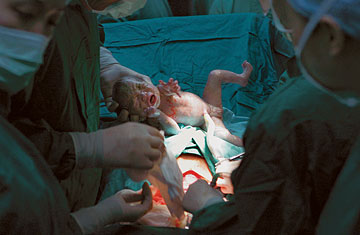
Slice of life: Despite the risks, large numbers of women are opting for C-sections to avoid birth pain and to control the date of their baby's arrival
Expectant parents, spare a thought for Mrs. Jacob Nufer, who in 1500 found herself in agonizing labor. More than a dozen midwives of the Swiss town where she lived had tended to her for days, with no sign of the baby. Facing the likelihood of losing mother and child, and in the absence of any surgeons, Mrs. Nufer's husband, a swine gelder, decided to cut her open and extricate his offspring. Because there had, at this time, been no known incidence of a woman surviving such a procedure, the couple would have said what were assumed to be their last goodbyes before Jacob Nufer made the first incision.
As it turned out, mother and baby lived. While it would be nice to say that this had something to do with Mrs. Nufer's constitution or her husband's skills with a knife, it was almost certainly because Mrs. Nufer's pregnancy was extrauterine — a freakishly rare form of gestation in which the baby grows outside the womb, in this case probably in the abdomen. Had the baby been inside the uterus, as normal, Mrs. Nufer would have bled to death when the uterine wall was breached. While some contest the accuracy of the story, Mrs. Nufer's is generally accepted as the world's first completely successful cesarean, or C-section.
Five hundred years later, surgical delivery seems as trifling as tooth extraction. In Chile, which is currently believed to have the world's highest cesarean rate, 40% of all births are in the operating theater. But larger populations in Asia mean that greater numbers of C-sections are performed in this region, particularly in South Korea (36.4% of all births in the first half of 2006), Taiwan (with a rate of roughly 33%), Singapore (about 30%) and China (approximately 26%). In Thailand, Dr. Stephen Atwood of the maternal and child-health section of UNICEF's regional office, says, "I've seen statistics from Bangkok General Hospital that suggest the national rate is as high as 65% of all births." (The actual figure is unknown — the Thai Ministry of Public Health told TIME that it does not keep statistics.)
Because cesarean delivery is associated with higher maternal mortality and other health issues, these figures are alarming to some medical practitioners and natural-childbirth advocates, who label the Asian trend an epidemic. Their concern has been exacerbated by statistics recently released in the U.S., showing an increase in the cesarean rate — now at 31% of all births, up 50% from 10 years ago — coinciding with a rise in maternal mortality (although the nature of the correlation is not clear-cut and is debated by some experts). For every 100,000 births in the U.S. in 2003, 12.1 women died — the first time the figure exceeded 10 in 26 years. The number rose to 14 in 2004. Figures for 2005 and 2006 are being compiled. After a decade's study of cesarean birth, Professor Eugene Declercq of the Boston University School of Public Health cautions against giving too much weight to the cesarean-mortality connection, but concedes that "there is some evidence of higher maternal mortality rates in cases of cesareans to low-risk mothers," and suggests that a woman contemplating a C-section should ask herself why she should undergo major surgery "when she and her baby are healthy."
Nobody questions the rightness of cesareans performed in a medical emergency (which account for up to 20% of the total), but those made simply at the request of the mother, known as "elective cesareans," are associated with a number of pitfalls. Before these are addressed, however, it is worth remembering that vaginal delivery is not always an appealing alternative.
Utter the phrase "natural childbirth" and the mind envisages a stoic and earnest woman, surrounded by murmuring midwives in a softly lit room, where ambient music plays and tea lights flicker. Upon the elapse of some decent, manageable labor, she pushes out her baby with honest grunts. While that may be true for some, for most women natural childbirth is one of the most violent physical traumas they will ever experience, bar a serious accident or grievous assault. The average length of labor for a first-time mother is anything from seven to 12 hours, but it can easily be 20 hours or more. During that time, she is wracked by contractions — a euphemism that doesn't even come close to conveying the violent spasms that take hold when the body reflexively tries to squeeze a baby through a narrow vaginal opening. The forces involved are such that when the baby's head emerges, it can do so with sufficient pressure to rip the mother's perineum and leave grind marks on pubic bone. In many ways, the act of giving birth resembles a medical emergency — in fact, if no medical intervention of any kind were made, up to 1 in 67 women would die in labor. Fear of birth pain is thus legitimate and it is no wonder that many women elect to have C-sections — especially when the procedure is over in about 40 minutes and feels no more uncomfortable, in the words of an anesthetist in one of Hong Kong's top maternity hospitals, "than someone rummaging around in your tummy." When cost is not an issue, women express even greater interest in cesareans. In Hong Kong, just over 45% of private-hospital births are surgical, compared to a territory-wide rate of 27%.
"You often hear people express the wish to have a less painful delivery," says Dr. Gabriel M. Leung, professor in translational public health at the University of Hong Kong. "They may also want some predictability in the time and day the baby is born" — allowing for a smoother departure from the workplace, and letting fathers and grandparents know when to take time off. The famous Asian penchant for astrology can even be indulged. "Whenever there is an auspicious date, there will be a planned cesarean," says Singaporean doula Ginny Phang (a doula is a private birthing coach who is not part of the hospital team).