

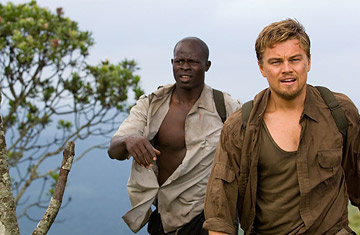
Leonardo DiCaprio and Djimon Hounsou in Blood Diamond
Clark Gable's naked pecs might have started it. In a racy scene with Claudette Colbert in It Happened One Night, Gable unbuttons his shirt to reveal--to the shock of 1934 audiences--a bare chest. No undershirt. Legend has it that undershirt sales dropped 75% that year. While never verified, the tale lives on because Hollywood loves it. If Gable's chest can have that kind of mass cultural impact, the thinking goes, then movies, far from being just passive entertainments, can influence audiences to change their behavior in more significant ways. If a movie can doom undershirts, can't it also end war, poverty, global warming, torture, obesity, junk mail?
More and more, Hollywood is betting on its powers of social engineering. Stars like Leonardo DiCaprio, Angelina Jolie, George Clooney and Charlize Theron have taken pay cuts and strolled red carpets for features that further humanitarian or political agendas. Big-name directors have put their reputations on the line, and rich men have risked fortunes for passion projects. This spring there are at least eight projects with a strong social agenda hitting theaters from such noteworthy filmmakers as Errol Morris and Morgan Spurlock as well as from message-movie newcomers like Ben Stein.
"In college I was really cynical about the idea that film can make a difference," says Brett Morgen, 39, who directs activist cinema's latest entry: Chicago 10, the animated political history of the Chicago Seven. "To me, that all changed with An Inconvenient Truth. It became an inspiration for all of us." Former AOL executive Ted Leonsis coined the term filmanthropy to describe his four-year-old production company, Agape (Greek for unselfish love). "It's difficult to rationalize independent movies as a business," says Leonsis, who financed Nanking, a 2007 documentary about the "rape of Nanking," and Kicking It, a film about the Homeless World Cup, which premiered this year at the Sundance Film Festival. "Filmanthropy changes the metrics of measurement from box office and revenues to number of volunteers and amount of money raised." As august a body as the United Nations is getting in on the act, announcing in January a $100 million U.N. film fund aimed at combatting stereotypes--in other words, undoing the work of almost all the other media we see.
But even using Leonsis' metrics, how can you measure a film's success? Chicago 10 was financed by Participant Productions, founded in 2004 on a "double bottom line" premise. "We want to make a social return and a commercial return on our investment," says Participant president Ricky Strauss. The production company has backed 39 other movies, both documentaries and features, including Syriana and The Kite Runner, and has more than 20 films in development. All its movies have social-action campaigns: Participant encourages audiences to visit its website takepart.com and register to vote, contact Congress or urge divestment from Sudan. About 2.7 million people have gone to the activism section of the site, 400,000 of them to calculate their carbon emissions. After the 2005 release of Syriana, Clooney's movie on the oil industry, the audience sent 8,000 e-mails to Congress.
But Participant also financed North Country, a feature based on a historic sexual-harassment case, which left no real mark. People weren't interested in the issue, and Theron, even in coveralls, couldn't get them to be. DiCaprio has also mapped the limits of his drawing power. His African thriller Blood Diamond showed the connection between some diamonds and war. It did a not-too-shabby $57 million at the box office, but activists say there are still conflict diamonds in the mix, and diamond sellers have not reported a surge of young engaged couples asking for a diamond's certificate of origin. Meanwhile, DiCaprio's greenie documentary The 11th Hour made just $700,000. "There's a 99% chance your film won't have an impact," says writer-director Paul Haggis, whose movies have tackled racism (Crash), euthanasia (Million Dollar Baby) and the mental health of Iraq-war veterans (In the Valley of Elah). "It would be hubris to think otherwise."
Not everyone agrees. "Does a movie change policy? Change behavior? Do movies have an influence on people? Of course they do! Who would argue otherwise?" says Morris, whose documentary Standard Operating Procedure, an examination of the Abu Ghraib prison photographs, comes out April 25. Morris has reason to believe in the persuasive power of cinema: his 1988 film about the murder of a police officer, The Thin Blue Line, got a man out of prison. Most movies' legacies are trickier to measure, however. In a TIME poll of 1,002 registered voters, about 30% of respondents said a movie had changed their mind about an issue. Fewer than 20% said a movie had persuaded them to donate money to a charity or inspired them to volunteer for a cause. And only 10% said a movie had caused them to vote differently.
And then there's An Inconvenient Truth. Al Gore's 2006 slide-show passion project made $24 million at the U.S. box office--no threat to Harry Potter but a blockbuster for a documentary. Covered in newspaper style pages and on entertainment shows, it received more than four times as much media attention as the 2001 Intergovernmental Panel on Climate Change report, which, shockingly, was overlooked by E! More than 1,000 people in the U.S. were trained to give Gore's presentation, 110,000 teachers downloaded a curriculum, and the movie became part of the syllabus in some schools in Britain. Three months after the film's U.S. release, California passed sweeping legislation to curb greenhouse gases. In the days leading up to the legislature's vote, one of the bill's co-authors hosted free screenings of the film. "For policymakers, the release of a movie becomes a focusing event, like a natural disaster," says Matthew Nisbet, professor of communications at American University.
But it has to be noted that the people who saw Truth already cared enough to spend leisure time watching a lecture about melting polar ice caps. It's not clear minds were changed. The converted saw the film and worried more; the rest went to Pirates of the Caribbean: Dead Man's Chest.