

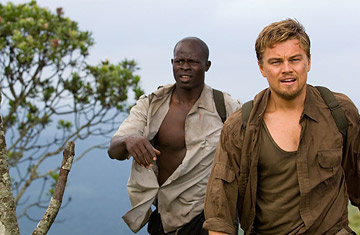
Leonardo DiCaprio and Djimon Hounsou in Blood Diamond
(2 of 2)
Similarly, Sicko, Michael Moore's doc about the American health-care system, had a deep rather than broad impact. The film, which made slightly more money than Truth, "has done more for public awareness [of universal health care] than any other single event in the movement," says Joel Segal, a staffer assisting Congressman John Conyers on a universal-health-care bill. "I don't think it's a coincidence that all the Democratic candidates--presidential and congressional--are pushing universal health care as a front-burner issue." A Kaiser Family Foundation poll found that as a result of Sicko, 43% of people were more likely to report that they think health-care reform is needed. However, the effect was not universal--43% of liberals had a positive view of the film, compared with just 9% of conservatives.
Some issue movies have become for liberals, who are more than twice as likely as conservatives to say they prefer documentaries, what talk radio is for conservatives: a way of rallying the base. Many follow the pattern of the $370 million--grossing 2004 juggernaut The Passion of the Christ. Fewer than 0.1% of those who saw the film said they became Christians as a result, according to a Barna Group poll, but 18% of the audience said some aspect of their religious behavior changed--mostly praying and attending church more.
Do movies make a difference? They can but often not in the way filmmakers hope. They're not for nonbelievers. They don't make bigots tolerant, Hummer drivers conservationist or burger eaters vegan. Movies make advocates out of supporters. They change the world not in wide swaths of multiplexes but one popcorn bucket at a time.
The artist who works with gunpowder Art, page 62