

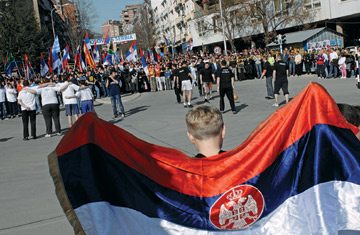
Serbs in ethnically divided Mitrovica protest against Kosovo's independence
(2 of 2)
An even bigger problem is unfolding in Kosovo itself. About 10% of its population are Serbs, most of them living in scattered enclaves. The largest adjoins Serbia north of the Ibar. Its main town, Mitrovica, which is split between ethnic Albanians and Serbs, is one of the most dangerous flash points in the Balkans. Serbs there, as elsewhere, not only refuse to recognize the authority of the ethnic Albanian government in Pristina; they are also taking steps to make that intransigence permanent.
The day after Kosovo's declaration, Belgrade's Minister for Kosovo, Slobodan Samardzic, went to Mitrovica and told local Serbs that Belgrade, far from abandoning them, would increase its presence in Serbian enclaves by strengthening parallel institutions there. Although Belgrade has, for example, paid the salaries of doctors and teachers in Kosovo since the war in 1999, Samardzic now says it will extend that largesse to "all government departments." And while Serbia's spending on Kosovo has already jumped tenfold in the past year, to $750 million, it will now grow further. At the same time, Belgrade is opposing U.N. and E.U. attempts to carry out their missions to Serb areas in the north. Attacks on two U.N. customs posts in northern Kosovo on Feb. 19 were not ordered by Belgrade, but they were "in accordance with government policy," Samardzic said. (The minister declined TIME's request to be interviewed.) Serbian hardliners have some powerful allies. Russian presidential candidate Dmitry Medvedev, in his first official trip abroad since being named likely successor to Vladimir Putin, told Serbs in Belgrade that Russia would join with Serbia in a "common policy" against "illegal recognition" of Kosovo, noting: "We have made a deal to coordinate our efforts to get out of this complicated situation." Medvedev, who also chairs the gas giant Gazprom, came to Belgrade to cement a $1.5 billion pipeline deal and the purchase of Serbia's state oil monopoly; some observers see that latter deal, on favorable terms for Moscow, as a quid pro quo for Russia's support of Serbia over Kosovo.
Some Serbs don't much like the direction their country is taking. President Boris Tadic, for example, is a moderate who still wants Serbia to join the E.U. But he and his backers are being sidelined by Prime Minister Kostunica, who wields more power, and Tadic's photo has been burned at rallies. In the current atmosphere, pro-Western positions are increasingly untenable. Tabloids are whipping up nationalist sentiment with attacks on the West and on moderate Serbs alike, and about a dozen journalists have been beaten up in recent days. "It's not funny anymore," says Pedja Obradovic, news editor of B92, an independent broadcaster whose founder has received death threats. Western officials have called on Kostunica to show restraint. He has replied that he will "normalize" relations with the E.U. only when its members rescind their recognition of Kosovo. "He wants to keep the pot boiling," says a European diplomat.
From one perspective, Serbia's reaction has been a success. Most countries have yet to recognize Kosovo, a fact that some Serbs attribute to their vocal protests. The new state certainly won't be joining the U.N. any time soon, and partition of Serb areas in northern Kosovo is starting to look inevitable, diplomats say. But for those gains, Serbia risks sacrificing its relations with much of the world. The loss of Kosovo may be bitter, but the loss of ties with Europe could be more bitter still. "The danger is that voices of moderation, like stones in a stream, are being washed away," says a European diplomat. The consequences could far outlast Serbia's current rage.