

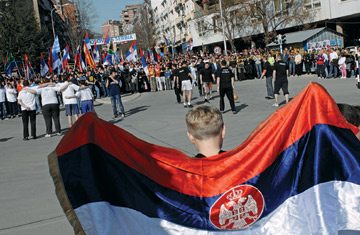
Serbs in ethnically divided Mitrovica protest against Kosovo's independence
The dark-clad crowd at a cemetery in the Serbian town of Novi Sad listened respectfully to the tributes at the Feb. 26 funeral of Zoran Vujovic. The rector of his university said the 20-year-old Serb had died expressing "justified anger" at the West. His uncle called him "one of the many martyrs of Kosovo." And the tabloid Pravda declared: FAREWELL TO THE SERBIAN KNIGHT! Amid the eulogies, the circumstances of the engineering student's death bear recalling: having broken into the U.S. embassy in Belgrade on Feb. 21, he was incinerated when a fellow protester tossed in a Molotov cocktail. For the mourners, Vujovic was simply doing his duty as a Serb by opposing Western recognition of the breakaway province of Kosovo.
Vujovic was hardly alone in embracing that cause. Since Kosovo's declaration of independence on Feb. 17, thousands of demonstrators across Serbia and Kosovo have taken to the streets. They have thrown grenades at the United Nations courthouse in northern Kosovo, destroyed two customs posts, and clashed with ethnic Albanian police. Student demonstrators have rallied daily along the Ibar River that divides Serb from Albanian areas in the northern Kosovo town of Mitrovica, chanting, "Kosovo is Serbia!" and "Kosovo is ours!" For Marko Jaksic, head of the Serbian National Council in Mitrovica, such action is not optional; a failure to rebel against "the formation of another Albanian state," he told a Serbian crowd in northern Kosovo, is "tantamount to treason."
The targets of this latest round of Serb bitterness are the mostly Western countries — around 20, so far — that have officially recognized Kosovo as a new state. The Serbian government itself, diplomats say, may have indirectly sanctioned the brazen attack by hooded protesters on the U.S. embassy and other Western embassies. Belgrade is also taking steps to undermine the fledgling state itself by encouraging the partition of Serb-dominated areas in northern Kosovo. Though a new Balkan war seems unlikely, Kosovo's birth is proving messier than its backers expected. And Serbia, which had been edging toward membership of the European Union and NATO, instead faces a degree of international isolation not seen since strongman Slobodan Milosevic was in power. Taken aback by all this anger and acrimony, Goran Svilanovic, a former Foreign Minister now working on regional cooperation, admits: "We didn't see this coming."
Not many did. But it's not wholly by chance that Serb fury over Kosovo's secession has outstripped expectations. Serbia's nationalist leaders have been stoking confrontation. For example, surveillance cameras recorded police being ordered to leave their posts minutes before the crowd gathered for the attacks on foreign embassies; some did not return until 45 minutes after the first rocks began to fly. Yet Serbian Prime Minister Vojislav Kostunica later declared himself satisfied with the performance of his police force, and Transport Minister Velimir Ilic even remarked that the damage done to the embassies pales next to Serbia's suffering over the loss of Kosovo. Foreign ambassadors, he said, "fared really well, considering what they deserved."
The U.S. has reacted by sending non-essential staff out of the country, and other nations may follow suit. Germany has suspended the issuing of visas from Belgrade. U.S. ambassador Cameron Munter slams "hardliners" for inciting violence. "We're really angry that this happened," he says of the embassy attacks. "It must not happen again." He adds, however: "We aren't yet confident that we are safe."