

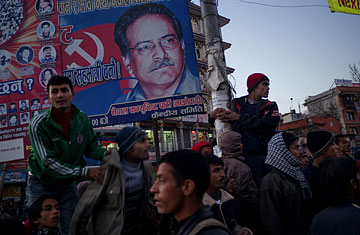
Revolutionary fervor: Maoist leader Prachanda, on a Kathmandu billboard, above, says he's ready to play politics.
(3 of 3)
The End of Kings
The threat of a coup may be exaggerated, but it points to perhaps the single greatest achievement of the Maoist insurgency: the unraveling of a national myth. Nepal came into being through the 1768 military campaign of King Prithvi Narayan Shah and his army drawn from Gurkha tribes in the hills near Kathmandu. Ever since, Nepal's polity has remained largely unchanged: its borders an approximation of the land conquered, its political élites tied to old families close to both the monarchy and the army, and its princely rulers all descended from the same messianic line. Power and legitimacy radiated outward from the palaces of Kathmandu into a highly hierarchical society in the countryside, where feudal mores and caste discrimination still hold sway. Propped up first by the British, keen to have a client buffer to the north of its imperial heart, and later India, this arrangement rarely had to fear outside interference and had remained roughly intact for more than two centuries.
Nepal's monarchy hammered the nail in its own coffin in spectacular fashion in 2001, when Crown Prince Dipendra gunned down 10 members of the royal family, including the much beloved King Birendra, and then allegedly shot himself. The attack, clouded by conflicting reports and conspiracy theories, sent shock waves around the world and plunged Nepal into existential crisis. With a centuries-old dynasty virtually eliminated overnight, in stepped the reigning King's brother, Gyanendra. As the Maoist insurgency raged, Gyanendra declared a state of emergency in 2005, arresting mainstream political leaders and assuming absolute power. But he could not quash the Maoists, whose influence grew apace in rural areas around the country. Rumors swirled depicting Gyanendra as a man given to superstition and mysticism, who would sooner look to the stars or a coterie of tantric priests for counsel than his political advisers. "He wanted control, he wanted to be a heroic savior," says a source close to the court, "but he had few actual ideas, if any."
Gyanendra's power play worked to the advantage of the Maoists. Their urban cadres and activists played a prominent part in the 19 days of mass demonstrations in April 2006 that ended King Gyanendra's absolute rule and led to the reconvening of parliament. The surge of popular goodwill at the time catapulted the guerrillas out of their jungle redoubts and into the international limelight. Prachanda, whose very existence had been in doubt only a few years before, appeared on televisions regionwide, saluting crowds and pressing the flesh. A King had been toppled, a war ended, and change in Nepal looked very much on the way.
The Way Forward
Little has gone according to script since the people-power protests 22 months ago. In November 2006, the Maoists committed to a peace accord with other prominent pro-democracy parties in Nepal and joined the new interim government that would rule until elections for a Constituent Assembly could take place. But the acrimonious squabbling that followed has dispelled many of the hopes raised by the success of the mass demonstrations. "We just felt so proud being Nepali then," says Sanjog Rai, a college student in Kathmandu. "The protests showed us how united we were and that feeling of brotherhood gave us real hope for a better future. Now we're stuck with politicians who have no vision and only care about keeping power."
There is a broad consensus among Nepal's strife-worn people that parliamentary democracy must come sooner rather than later. "A functioning government can't be in a permanent state of transition," says Bojraj Pokhrel, chief of Nepal's Electoral Commission. Now, Pokhrel will have to manage a staff of over 230,000 election workers spread across the mountainous country, some in polling stations miles away from local roads. Highways and bridges were routinely bombed during the civil war, making transportation in a nation with woeful infrastructure difficult at the best of the times. Still, Pokhrel is confident Nepal has the means to carry the elections out. "The people are all hungry for this," he says.
But they'll remain disappointed as long as the interim government's leaders fail to forge any meaningful political unity. "It's a testing time for them," says Acharya, the former ambassador to the U.N. "One wonders if they'll prove their statesmanship." The only indication that they will, most observers drily point out, is that neither the Maoists nor the Congress Party have any better alternative other than sorting out their differences and calming the many fractious forces that might undermine April's polls.
If they don't, the international community must do more to safeguard elections and move the peace process forward. Nepal's giant neighbors, India and China, both backed the monarchy during the civil war, supplying it with weapons and aid. India, which has close ties with virtually every faction in Nepal, eventually shepherded the peace process along, forcing the main political parties to come to terms with the Maoists. China has remained a bit more circumspect, letting India flex its geopolitical muscle while building bridges with the Nepali Maoists it shunned until not long ago and beefing up its hydropower investments along Nepal's glacial rivers. As the budding superpowers expand in influence and ambition, many see Nepal falling into the crosshairs of a new "Great Game" for the 21st century.
Beyond the turmoil and political intrigue looms the very real chance that Nepal might join the region's sorry list of failing states — populated already by Bangladesh, Sri Lanka and Pakistan. Besides forging alliances and staging elections, the country and its politicians need to steel themselves for the thorny task of drafting a constitution that reconciles its feuding factions and enfranchises all its kaleidoscope of ethnic groups. "This is a crisis hundreds of years in the making," says S.D. Muni, a Nepal scholar formerly at Jawaharlal Nehru University in New Delhi. "Whole groups have never been in the political structure. You have to in effect create a new Nepal."
Back in Sandhya's Chitwan camp, the commander, named Biwidh, clings to such hope. From a poor, indigenous-minority family, he speaks urgently of peace and of the need for a competitive, multiparty democracy. A slight man with a scarred, weathered face, Biwidh looks much older than his 34 years, and describes his time spent warring in the jungle with primitive rifles and stones in hushed, quick breaths, as if he would rather forget about it. As Nepal lurches from one crisis to another, Biwidh says the soldiers in his camp are in a permanent state of readiness. "If the revolution must be fought again," he sighs, turning his head to the setting sun, "it will be."