

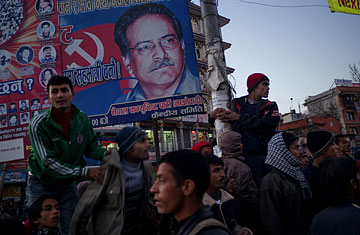
Revolutionary fervor: Maoist leader Prachanda, on a Kathmandu billboard, above, says he's ready to play politics.
(2 of 3)
A False Dawn
The security situation in a nepal under cease-fire is dismal. During the civil war, both the Maoists and the Royal Nepalese Army held brutal sway over segments of the country, but now, as they wait in their camps, law and order has deteriorated. Reports filter in every week of kidnappings for ransom. Last December, a Swiss trekker was beaten up after refusing to pay money to a few rogue Maoists, a worrying sign for a country heavily reliant on the money brought in by foreign tourists. Many in Kathmandu blame the Youth Communist League (YCL), created by the Maoists less than a year ago, for much of the disorder. Red YCL banners around parts of Kathmandu urge Nepalis to report "suspicious, reactionary activity" to cell-phone numbers emblazoned on the cloth. As soon as night falls in the capital — which, as a bastion for the King's army, had been safe during all of the years of the civil war — the usually teeming streets grow deserted. "The police have no motivation at all right now," complains Kanak Dixit, editor of Himal magazine and an outspoken advocate of democracy. "There is an alarming surge in crime."
Public safety isn't the only challenge the interim government has failed to negotiate. Fiscal mismanagement has led to chronic fuel shortages across the country; lines in Kathmandu extend for kilometers and prices have tripled in less than half a year. Last week, protests against rising fuel prices shut down the capital. Kathmandu residents face at least six hours of power cuts a day. The government has been unable to raise Nepal's middling growth rate, which hovers around 2%, and funds many of its programs on an IV drip of foreign aid. Trade-union activism and general strikes, some suspect spurred in part by the YCL, disrupt factories in outlying areas and basic services in the cities. During Christmastime around Kathmandu, sanitation workers had been agitating for over three months. Piles of garbage festered around every cobblestoned corner of the city, visceral reminders of a deeper rot seeping into the nation.
"We live in a broken state," says Mandira Sharma, a leading human-rights activist. For the past five years, she and her NGO, Advocacy Forum, have investigated hundreds of cases of disappearances that took place during the decade-long civil war. To Sharma, both the Maoists and the Nepal Army are guilty of a catalog of atrocities, from forced recruitment to extrajudicial killings. Attaining justice for the victims (and compensation for the nearly 200,000 displaced) ought to be as important to the country's push toward democracy as elections. "But human rights don't seem to be anyone's priorities here," she laments. "The problem is a failure of political leadership."
Elections for a Constituent Assembly, which have thus far been canceled twice, became the focal point of political squabbling. The first date, June 17 last year, was missed for mostly logistical reasons. Nepal simply wasn't ready at the time to hold a fair and efficient poll. But the Maoists scuppered the next date, November 22, much to the chagrin of many Nepalis as well as the international community. Reneging on earlier understandings, the Maoist leadership grandstanded on a set of demands that included the outright abolition of the monarchy before its fate could be determined by popular referendum. When the other parties — including the establishment Nepali Congress, the party of the country's current Prime Minister Girija Prasad Koirala — refused to accede to the Maoist agenda, the Maoists pulled out of the government and plunged the peace process into a rancorous impasse.
"It showed how unnatural the alliance is between all the interests in the interim government," says Kamal Thapa, a royalist politician who served as Home Minister under Gyanendra. Up till last year, the Congress Party had always defended the idea of constitutional monarchy, a commitment enshrined by their party following similar protests in 1990 that curbed royal power. But the need to assuage the Maoists changed the equation. "The Congress has had to understand the new political reality," says C.P. Gajurel, a top Maoist politician, "and it has been difficult for them."
The Maoists see themselves as the agents of democracy in Nepal, stifled by the objections of reactionary, status-quo forces, while many in the Congress, let alone in factions aligned still to the ancien régime of the monarchy, doubt the radical guerrillas' commitment to any political scenario where they may not retain complete control. Despite a compromise thrashed out at the end of last year, which set elections for this April, observers expect conflict to be inevitable. "What more must we give the Maoists?" asks R.S. Mahat, Nepal's Finance Minister and a Congress Party member. "Their strategy is simply to create crisis. They are not honest."
This distrust speaks volumes of Nepal's present predicament, where parties spar over everything from the distribution of ministries to the appointment of ambassadors. "There is no genuine consensus at all," says Rhoderick Chalmers, Nepal expert for the International Crisis Group. Continued discord only strengthens the hand of the weakened King. Though the throne has lost much of its credibility under Gyanendra, many Nepalis still look to the institution as a source of stability and unity. "You can't legislate away the emotional link of the people," says Thapa. Others, including journalist Dixit, fear further squabbling and political anarchy could lead to a more ominous "right-wing backlash ... where royalist elements in the army would step in on the pretext of stability." Further heightening tensions, Prachanda, the Maoist leader, made noises as recently as November about returning the people's war to the jungle if progress toward a republic wasn't made. "Either through [the Maoists] or through the army," warns royalist Thapa, "we are going to see some sort of authoritarian solution."