

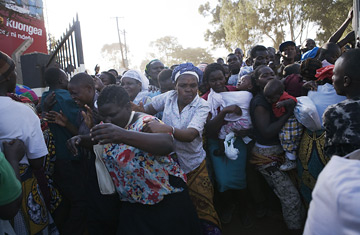
As violence racked the country, desperate residents of Nairobi's giant Kibera slum stormed a health center where the Red Cross was distributing food
(2 of 2)
After a week of violence, Kibaki and Odinga came under heavy international pressure--and intensive lobbying by African leaders like Tutu and Ghanaian President John Kufuor and by U.S. Assistant Secretary of State for African Affairs Jendayi Frazer--to reach some sort of compromise. But the question of who would rule was unresolved, leaving many Kenyans worried that the furies unleashed by the stolen election would lurk close to the surface, ready to break out at any time.
As Goes Kenya ...
What makes the unrest in Kenya most alarming is that its root causes are maladies that still plague other, less stable African states. The first is poverty. Despite Kenya's overall economic growth, 58% of its people are poor (defined as living on $2 or less a day). U.N. studies show that the gap between rich and poor is wider in Africa than anywhere else in the world. Despite the continent's recent economic growth, the number of its poor grew from 288 million in 1981 to 516 million in 2001.
The second malady is corruption. Kenya ranks eighth from the bottom on the list of the world's most corrupt countries, compiled by the watchdog group Transparency International. Kibaki's government and that of his predecessor Daniel arap Moi have been dogged by allegations of dirty deals running into hundreds of millions of dollars. Kibaki's former anti-corruption czar John Githongo went into self-imposed exile in Britain in 2005 after he became disillusioned by the President's lack of commitment to fighting graft and faced death threats. The government, he tells TIME, had "abandoned promises to equitably share power and economic opportunity, reform the constitution and fight corruption." Fixing the election result, he says, was "like throwing a match into a fuel drum."
As in Kenya, so in Africa's other powers. Africa is the also the world's most corrupt continent, with 36 out of 52 countries afflicted by rampant graft. In Nigeria the Economic and Financial Crimes Commission says the country's rulers stole $400 billion from 1960 to 1999. In South Africa barely a week goes by without a new corruption scandal among the business and political élite. A week after he was elected leader of the ruling African National Congress, Jacob Zuma was indicted on one charge of racketeering, one of money laundering, two of corruption and 12 of fraud in connection with bribes paid by a French arms company. (He denies all the charges.)
Finally, Africa's democratic institutions remain weak. Like Kibaki, many African leaders have a hard time accepting an unfavorable verdict from the electorate and walking away from office. "Democracy in Africa is not what is understood in the West," says Catholic bishop Cornelius Korir, whose cathedral in the town of Eldoret, north of Kiambaa, has become a refugee camp for 9,000 Kikuyus. "Since their wealth depends on power, our leaders are never ready to admit defeat." Incumbents like Kibaki, Zimbabwe's Robert Mugabe and Uganda's Yoweri Museveni are among those who tried to alter their country's constitutions--some successfully--to cling to power. African voters are to some extent complicit in the undermining of democracy. When given an opportunity to vote out one corrupt leader, they often elect another, hoping he will be more generous with his ill-gotten gains.
Reason for Hope
So what can be done--for the people of Kenya and their 788 million fellow sub-Saharan Africans? For the West, part of the answer lies in holding African governments accountable for the graft and misrule that sow popular disgruntlement. The West largely contents itself with the appearance of democracy in Africa, not the reality, and gives billions of dollars in aid to corrupt governments. "The World Bank runs around establishing anti-corruption commissions," says Joel Barkan, a senior associate at the Center for Strategic and International Studies in Washington who was in Kenya for the vote. "They have been singularly ineffective." In Kenya the IMF and the World Bank suspended aid in 2006 but later resumed it. Threats to withdraw U.S. and other aid appear to have persuaded Kibaki to offer to share power with Odinga.
Ultimately, the emergence of a more peaceful, prosperous Africa depends on Africans themselves. That provides the strongest case for optimism. Some of Africa's most thriving states are places that recently seemed beyond hope. Rwanda, where tribal violence escalated into genocide in 1994, is reviving with relatively little corruption and subsiding tribalism. The IMF expects Liberia, shattered by civil war from 1989 to 1996 and again from 1999 to 2003, to post economic growth of 13.3% this year. There is hope for Kenya too. After all, the majority of Kenyans chose not to join in the tribal violence. Many civil-society institutions are strong and cut across tribal lines. Journalists, church leaders, women's groups, lawyers, tourist operators and even some politicians have united to condemn both the mobs and Kibaki, calling for an end to the killing and for the President to quit.
Still, memories of Kenya's unhappy New Year's Day won't fade easily. On Jan. 2 in Mathare, another Nairobi slum, a mob of people torched a gas station, burned three buses and two jeeps and slashed a Kikuyu man in the head with a machete. They chased another down a narrow mud alley and, when he slipped, beat him to death with rocks, then stole his wallet and shoes. There was nothing on the body to identify him, no one in the area knew him, and within hours he joined hundreds of corpses at mortuaries across Kenya, awaiting claim. Unknown. But not forgotten.
Mixed Picture
[This article contains a complex diagram. Please see hardcopy or pdf.]