

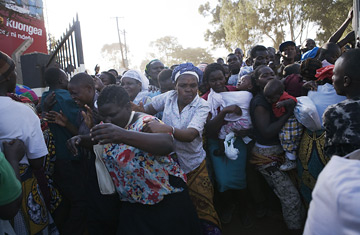
As violence racked the country, desperate residents of Nairobi's giant Kibera slum stormed a health center where the Red Cross was distributing food
High up in the mountains of the northern Rift Valley is the village of Kiambaa, a place of maize farms and mud huts where the air is so light and pure, it is said to hold the secret of Kenya's world-beating distance runners, who train in the surrounding hills. On New Year's Day, a mob of several hundred people armed with machetes, clubs and bows and arrows surrounded Kiambaa's tiny tin-roofed church, where up to 200 men, women and children were huddled. The mob freed those who gave up mobile phones or money, raped the women, then closed the doors on the rest, heaped mattresses and dry maize leaves against the entrances and set them alight. The Kenyan Red Cross pulled 17 bodies from the ruins. Survivors put the death toll at 35.
At least one body, that of a young man called James, lay in a nearby field, where he collapsed after running out of the church with his hair and face on fire. Daniel Mwangi Nganga, 37, whose disabled brother was hacked to death in the family home as the crowd approached the church, recognized the killers as friends and neighbors. "We went to school together," he says. "They used to come to our homes. We prayed together." He searched for an explanation. "We just don't know what happened."
It wasn't supposed to happen in Kenya. Until a few weeks ago, this country of 37 million was a poster nation of the African renaissance, a term adopted by South Africa's President Thabo Mbeki to describe the continent's economic and political resurgence in recent years. After three decades beset by genocide, famine, AIDS and wars as obscure as they were endless, much of Africa is thriving. Soaring demand for resources like oil, timber and minerals--especially from China--has pushed annual economic growth for sub-Saharan Africa to more than 5% for four years running and is inching toward 7%, according to the International Monetary Fund (IMF). Conspicuous activism by Western politicians, philanthropists and rock stars has helped relieve the continent's debts and deliver billions in development aid. There is less war and more democracy. Peace reigns in the old battlegrounds of Angola, the Ivory Coast, Liberia, Mozambique, Rwanda and Sierra Leone. Almost all African countries have held multiparty elections in the past 15 years.
Kenya is one of the stars of this revival: it has held elections regularly since independence in 1963, its economy grew 6.4% in 2007, and it has been a stable exception to turmoil in East Africa. But the outbreak of violence there following last month's presidential elections threatens that progress. A potential implosion in Kenya is especially worrying to the U.S. because the White House sees it as a frontline state in the war on terrorism, a bulwark against its volatile, jihadi-infested neighbor Somalia. Terrorists have occasionally slipped across Kenya's border, as in 1998, when al-Qaeda simultaneously bombed the U.S. embassies in Kenya and Tanzania, another neighbor. In 2007 the Bush Administration gave the government of President Mwai Kibaki about $1 billion in military and other aid. And there are special-operations soldiers based in Kenya at Manda Bay, on the coast just south of Somalia. The instability in Kenya has so alarmed the Administration that Secretary of State Condoleezza Rice reached out for help to an unlikely ally: Democratic presidential contender Barack Obama, whose father was from western Kenya and who has relatives near the city of Kisumu, the scene of some of the worst violence. Obama recorded a message, aired on the Voice of America, calling for calm. On Jan. 3, the day of the Iowa caucuses, he spoke with South African Archbishop Desmond Tutu, who had flown to Nairobi, the capital, to see if he could negotiate a peace. In the days since his Iowa victory, Obama has had near daily conversations with the U.S. ambassador in Nairobi, Michael Ranneberger, or with Kenya's opposition leader, Raila Odinga. Obama was trying to reach Kibaki as well.
Whether Kenya can be pulled back from the brink will reveal much about Africa's future. The nation embodies the best and worst of the continent--its vitality and economic potential but also its poverty, corruption and tribalism. So long as those conditions persist, crises like the one afflicting Kenya will continue to haunt Africa, stunting its growth and hurting its people. The outcome in Kenya may well determine whether Africa's renaissance sustains itself--or turns into another nightmare.
Roots of the Rage
The psychology of the bloodletting that has killed more than 500 Kenyans and forced hundreds of thousands to flee their homes may remain a mystery. Other questions are easier to answer. The immediate cause? A civilian coup by Kibaki, following a close race with challenger Odinga in the Dec. 27 general election. Three days after the vote, on live television, paramilitary police stormed the Kenyatta International Conference Center, where the vote was being counted and Odinga had a substantial lead. Minutes later, the head of the election commission declared Kibaki the winner. Kibaki was sworn in later the same day. That decision fanned simmering resentment against Kibaki's tribe, the Kikuyu, the largest of Kenya's 42 tribes. Though Kikuyus make up only 22% of the population, they dominate government and business. A 2005 report by the Society for International Development, a civil-society monitoring group, catalogued how Kibaki had packed his Cabinet, state corporations, the judiciary and provincial administrations with his tribesmen. The tribal animosities have been festering at least since 1963, when British colonial farmers sold their properties to wealthy Kikuyus, allowing them to encroach on the ancestral land of Luos, Kalenjins and others in the Rift Valley. Some blame also goes to the father of the nation, Jomo Kenyatta, a Kikuyu who founded the ruling Kikuyu cabal.
In Nairobi the epicenter of the violence was Africa's largest slum, Kibera, where a million people live in tin shacks and clapboard huts--without sewerage, hospitals or jobs--a five-minute drive from some of the city's most luxurious homes. Richard Dowden, director of the Royal African Society in London, describes Kenya's poor as the "explosive dispossessed," ready to erupt into violence.
They did. Starting on New Year's Eve, tens of thousands of Kalenjin and Luo tribesmen tore through the Kikuyu sections of Kibera, mirroring violence across the country. Few seemed to care whether Kibaki and his tribe would fight back. "If there's civil war, it is the Kikuyus who will lose," says Titus Odiambo, a Luo fish trader. "It's their buildings that will burn. We don't have anything at stake." Some Kikuyu gangs struck back, but tens of thousands simply fled to the central highlands, where they are the majority tribe.