

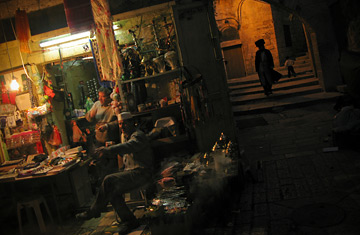
Orthodox jewish man is going towards the Western wall in the Muslim quarter of the Old city of Jerusalem, Israel, on the eve of Sabbath, November 16, 2007.
(3 of 3)
That straightforward bias toward life holds a lesson. Arabs and Jews will always view the past--and their city--in different ways. "The Israelis," says Seidemann, "will always look at 1948 as Independence Year, and the Arabs as [the time of] al-naqbah--the disaster." For Jews, 1967 was the moment that an undivided Jerusalem came under their jurisdiction for the first time since the Romans destroyed the temple; for Arabs, it was the year of another calamity. But whether they like it or not, Arabs and Jews are destined to live in the same small city. Alian, the volunteer ambulance driver, notes a recent change he has seen in his medical work. In the past, he says, many Arabs refused to give blood for fear it would go to the Jewish enemy. "Now they mind less," he says. It's a straw in the wind; Israelis and Arabs are destined to live side by side, to share streets, markets, falafel--even blood. But only if they share Jerusalem more equally can it be less hellish for all.
The City Of Faiths
Jerusalem, sacred to three religions, can't be neatly divided. Israeli settlements extend to the east, beyond Arab neighborhoods, while the Old City is a jumble of streets and faiths, attracting visitors from afar
[This article contains a diagram. Please see hardcopy or pdf.]
JERUSALEM...
...A PATCHWORK CITY
1 DOME OF THE ROCK
2 DAMASCUS GATE
3 Tisch Family Zoological Gardens
Distance from here: about 2.5 miles (4 km)
4 EAST JERUSALEM