

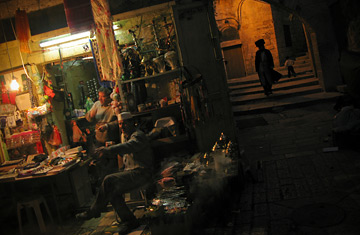
Orthodox jewish man is going towards the Western wall in the Muslim quarter of the Old city of Jerusalem, Israel, on the eve of Sabbath, November 16, 2007.
(2 of 3)
Arab refusal to cooperate with the Israeli authorities has some odd consequences. In a Jerusalem telephone book, for example, maps of Arab neighborhoods are blank, like unexplored parts of the Amazon in the 19th century. That's because no Arab sits on the municipal committee that chooses street names. On the rare occasion when the committee bothers with East Jerusalem, it is to irritate the Arabs by naming a few streets after Israeli war heroes. Mail is seldom delivered there, and having no street names adds to the Arabs' perception that in Israeli society they are either invisible, nonexistent or branded terrorists. Abu Walid Dajani, a hotel owner whose family has lived in Jerusalem for more than 700 years, recalls writing to Olmert when the Prime Minister was mayor of Jerusalem, outlining the daily humiliations those in East Jerusalem face. "If all our problems are related to security," he asked cynically, "why don't we have a mayor in army uniform?" Olmert, says Dajani, expressed sympathy--but the hotelier insists that the Arabs' second-class status remains unchanged.
Arabs might stand a better chance of improving East Jerusalem if they ran for office in local elections. They don't. Palestinian leaders in the West Bank warn that casting ballots is like collaborating with the enemy. So when the city council elections were last held, in 2003, only 4,000 of 125,000 Arabs voted. As a result, East Jerusalem's residents pay 30% of total municipal taxes, but they get back services worth only 5% of the city's budget. Israeli courts have said the municipality should add 1,400 new classrooms in the East, but so far city hall has built only five.
An Arab with a Star of David
For Arabs, it is axiomatic that their schools would be better--and their health services, their street-cleaning, their roads--if they had greater control over their own part of the city. At the same time, nobody wants to see barbed wire cutting Jerusalem in two, as was the case from 1948 to 1967. Those in East Jerusalem look to the Israeli side for work opportunities and health care. The mere rumor that Israelis and Palestinians might reach an accord in Annapolis prompted a flood of applicants for Israeli citizenship, but only a lucky few will get it; most East Jerusalem Arabs have Jordanian passports. The rush was telling; however much Arabs may feel harassed by Israelis, they fear that annexation of East Jerusalem by the current thuggish Palestinian leadership would lead to a spillover of the chaos and murderous political feuds that plague the West Bank and Gaza Strip, with rival militias fighting over spoils in the holy city. A new "Berlin Wall," says Seidemann, would devastate those who live in East Jerusalem. The average yearly income on the Arab east side is $4,000. That is far lower than the $19,000 a year earned by a typical Israeli in the west of the city, but more than twice as much as the average Palestinian earns in the West Bank. "The East Jerusalemites know that economically, life would be better under the Israelis than under [Palestinian President] Abu Mazen," says Seidemann.
If the city is ever to be legally divided--while maintaining its identity as a shared space--there are lessons to be learned from the thousands of Arabs who have figured out how to weave their way through Jerusalem's web of invisible barriers. They often dress like trendy young Israelis and, at army checkpoints, switch the car radio to Israeli music and speak a few words of Hebrew to soldiers. "I live in two different worlds," says Ammar Obaidat, who rose from gardener to head elephant keeper at the Tisch Family Zoological Gardens, "and I have to keep a balance between my work and traditions of my Muslim family. It's not easy." Shopping in the Jerusalem Mall, Obaidat speaks Hebrew with his wife and kids, hoping to blend in. But since his wife wears a hijab, or head scarf, the family is immediately tagged as Arab.
Obaidat is lucky. The zoo where he works is regarded as the one place in Jerusalem where Muslims, Christians, secular Jews in shorts and tank tops and ultra-Orthodox Jews wearing their 18th century finery all co-exist happily; director general Shai Doron thinks that's because the presence of other animals reminds visitors that despite their differences, they are all members of the same species. And Doron has no tolerance for ultra-Orthodox visitors who demand that he fire Arabs in the cafeteria because they might be plotting to poison Jews.
Arab ambulance drivers, like Arab zookeepers, have learned how to navigate Jerusalem's many borderlines. "I'm suspicious-looking in so many ways," laughs Nasser Izhiman, a volunteer driver and medic for the Magen David Adom (MDA) ambulance service. "An Arab guy wearing the Star of David on my jacket? Nobody knows what to think." In fact, Arab medics--MDA has 75 Arabs among its 1,500 Jerusalem volunteers but is trying to recruit more--are invaluable. Not only can they help serve East Jerusalem, with its maze of unnamed streets, but they are also indispensable for the city's hermetic ultra-Orthodox (or Haredi) Jews, who cannot accept help from a fellow Jew on the Sabbath. "When three Arabs turn up at the door, it's the last thing the Haredi expect, but they're grateful," says Izhiman.
Arab drivers won trust from their own community several years ago after they saved the life of an elderly Arab chieftain whose family members were Old City militants. In East Jerusalem, Arabs no longer hurl stones at MDA ambulances, once seen as symbols of the Israeli oppressor. Yet still, the divisions of the city leave their scars. The ambulances are allowed to enter Eastern neighborhoods only with a police escort. Waiting for police cars often wastes precious seconds during an emergency call, so Izhiman and his colleague Morad Alian will often collect the patient in their own cars and drive him to the idling ambulance, still waiting for the police escort.
Always, always, the pain and hurt of the city can break through and curdle the best intentions. Izhiman describes what it was like to cope with the aftermath of a suicide bombing. "We're trying to help the injured, and people are pointing at us, yelling, 'You're Arab! You did this to us, and what, now you're here to save lives?' It was like a knife in my heart." Adds Alian, "On the Israeli side, human lives are being lost, and the Arab side is demanding rights for statehood. I'm caught in between, angry and frustrated. All I can do is focus on my training and try to keep the wounded from dying."