

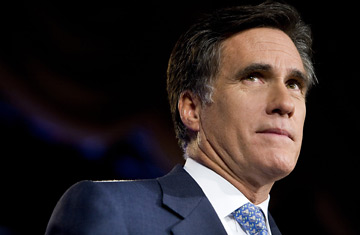
Mitt Romney.
The official story of how health-care reform was conceived in Massachusetts could hardly have been less inspiring--or promising. In the earliest days after Mitt Romney's election in 2002, goes the tale, the new Governor of Massachusetts sat down in his office with his old friend Tom Stemberg, founder of the Staples office-supply chain. "There are lots of things you can do to make this state better," Stemberg told him. "But if you really want to make a difference in the long term, you should fix the health-care system." Romney did not exactly jump at the prospect. It would cost billions of dollars; he was already facing a budget deficit and had promised not to raise taxes. Michael Dukakis had tried to tackle the same issue in 1988, and he provoked so much outrage from the Massachusetts business community that his plan was repealed before it ever went into effect. And then there was the cautionary tale of Hillary Clinton's disastrous experience with a national health-care-reform plan in 1994. "No, thanks," Romney recalls telling Stemberg. "It just can't be done." So that was that, Stemberg thought. "I just figured he'd forgotten about it."
Three and a half years later, Romney signed a law that made Massachusetts the first state in the nation to guarantee health coverage for all. It was the kind of accomplishment on which a Governor might want to build a presidential campaign. But these days Romney isn't trumpeting his health-care effort. In fact, when he does talk about the issue on the campaign trail, it is to call Hillary Clinton's proposal, which is strikingly similar to what he did in Massachusetts, a "European-style socialized-medicine plan." But if you ask him how he did it, as I did during an Iowa campaign swing, Romney becomes effusive. It may be that this tale from Massachusetts reveals what kind of President Romney could be. "He was incredibly impressive, with his intellect, his ability," says MIT economics professor Jonathan Gruber, a Democrat who advised Romney and who has since had a hand in the Massachusetts-style health-care plans put forward this year by Clinton, Barack Obama and John Edwards. "If there is anything that qualifies him to be President of the United States, it is his leadership on this issue."
Comparatively speaking, the health-care situation in Massachusetts wasn't all that dire when Romney took office: the state's percentage of uninsured among its nonelderly (13.2%) was smaller than the national average (17.8%), and it had a better safety net, thanks to a $1.1 billion fund the commonwealth had established to reimburse hospitals and health centers that provided medically necessary care to people who couldn't pay for it. But with a third of the state budget going toward health care, the sheer inefficiency of treating the sore throats of the uninsured in emergency rooms didn't sit well with the businessman in Romney even after he'd told Stemberg that health-care reform was not on his agenda. Meanwhile, religious groups and health-care advocates were pushing their solution: a liberal universal-health-care ballot initiative that would raise taxes. And the picture was about to get significantly worse: Health and Human Services (HHS) Secretary Tommy Thompson was threatening to take away $385 million a year in Medicaid money. The more the Governor thought about health care, the more intrigued he became by the idea of making it work better.
That whiff of a challenge was reinforced by the stories Romney heard as he traveled the state. After talking to a jeweler in North Andover, a man about his age, Romney remembers thinking, "Gosh, he's 55. He could have a heart attack. He could get cancer. He's got his own business, but he doesn't have health insurance? How can this be?"
So Romney started asking for ideas from his aides, many of whom--especially his political advisers--thought he should just drop it. "It was pooh-poohed by everybody," he says. "I am obstinate. I kept on drawing these squares: Well, if you have this number of people, you take that money, you move it there, couldn't that work? Let's do the math." State HHS secretary Ron Preston kept coming back to the one alternative Romney said he wouldn't accept: Dukakis' approach of requiring employers to either cover their workers or pay a hefty fee. "We didn't make as much progress as I wanted to," Romney says now. So the former management consultant did what he might have recommended to any CEO: he got a new team, showing Preston the door and giving the job to his policy director, former investment banker Tim Murphy. "The thing about Mitt," says Murphy, "is he wants to focus on the analysis."
When they considered the situation as if it were a business-school case study, some simple steps became clear, like getting the word out to the 106,000 Massachusetts citizens who were eligible for Medicaid but didn't seem to know it. Yet they also found something surprising when Romney began looking at who, precisely, the uninsured were in Massachusetts. Everyone expected the typical profile to be that of a single mother just scraping by or maybe someone with chronic illness--not exactly ideal customers for insurers. Instead, nearly the opposite was true. "It turned out they were largely single males, and they were working," Romney recalls. "They were eminently insurable. It's funny how data opens up new insight."
That was the bit of analysis that changed everything. Gruber ran the numbers at MIT: universal coverage would be expensive, but so would any half-measure. Romney could simply expand the existing system and, by doing so, cover about one-third more people. Or he could cover everyone by including an "individual mandate," a controversial measure requiring people to buy insurance and offering subsidies to those who couldn't afford it. The price tag would be about one-third higher. "I began by saying, Well, maybe we could help half the people that don't have insurance, maybe we could help a third of the people, and ultimately it became, You know what? We could actually get everybody insured!" Romney recalls.
In November 2004, nearly two years after his meeting with Stemberg, Romney was finally ready to go public with the beginnings of a plan. As it evolved, it became a proposal to achieve an end that liberals had long dreamed of, but through conservative means: creating more competition in the private-insurance marketplace and insisting that Massachusetts citizens take personal responsibility for their own coverage. "From the minute you heard him articulate it, you knew this was a new concept in American health-care policy," says Robert Blendon, a Harvard University professor of health policy. "It was a very different way of talking about coverage, and he was very articulate in framing it."