

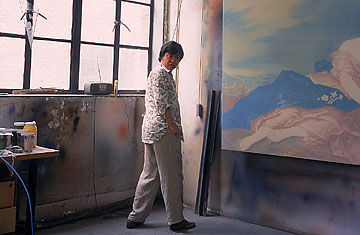
Shanghai artist Zhou Tiehai
(3 of 3)
Asia's artists aren't immune to the rampant consumerism they like to mock in their own works. As Indian and Chinese art have boomed, smaller markets like Vietnam have benefited from a spillover effect. "People say, 'Oh, Chinese art or Indian art is too expensive, so maybe we'll try looking in Vietnam,'" says Suzanne Lecht, the American director of the Art Vietnam Gallery in Hanoi. "Artists who could barely afford anything a few years ago can now drive luxury cars." But the rapid cash inflow has put commercial pressure on these artists to churn out foreigner-friendly images that don't stretch their imaginations. Many galleries are complicit, preferring to stock interchangeable images of women in conical hats strolling past crumbling French architecture. "Art students know they can make a good living painting these themes," says Gang of Five painter Luong. "It's difficult to convince them to be adventurous."
The art trade has become so frenzied in Vietnam that dozens of young painters are now employed by unscrupulous dealers to make copies of works by leading local artists. Le Thiet Cuong, for instance, paints deceptively simple rural scenes that evoke his childhood when he was evacuated to the countryside because of war. A prodigious painter, he is sometimes criticized for pumping out too much too fast. Yet part of his purported output comes courtesy of a bevy of knock-off specialists who hawk canvases adorned with his forged signature. Just down the road from a gallery that sells his real works for $5,000, another art space sells fakes for just $300. Cuong has tried to police these dishonest dealers, but it's dispiriting. "It's like trying to stop pirated copies of Hollywood movies," he says. "You cannot win."
Some Asian artists blame the consumerist hype on foreign collectors who impose their tastes — and dollars — on locals. "The foreigners already have an idea of what they expect from Chinese art, and they are more interested in works that have obvious Chinese symbols," says Shanghai artist Ding Yi, whose Mondrian-inspired geometries hardly betray his nationality. "It's very seductive," acknowledges Li Liang, the owner of Eastlink Gallery in Shanghai. "You know that if you put things up that look Chinese, they will sell well." But others worry that this impulse will only encourage soulless facsimiles with little cultural resonance. Yue Minjun's laughing heads, for instance, have spawned dozens of smiling faces by lesser artists. "We've reached the point where artists have to be honest with themselves," says Weng Ling, director of the Shanghai Gallery of Art. "Are you doing it for the foreign market or are you doing it for yourself? Chinese history is not just about the past 50 years, all that political pop that sells well. It's about 5,000 years of culture."
Even on a purely commercial level, endless neon Maos or identical riffs on the Ramayana will only saturate the market and, in the end, make artists' works less valuable. So, too, will a reluctance to explore different artistic avenues; imagine if Picasso spent his entire career in his Blue Period. Art critics worry that the current buying boom will only lead to creative stagnation — and that everyone from the artists to national governments are being blinded by money. "What people call avant-garde art in China has actually been co-opted by the government and is now mainstream," says Yang Zhenzhong, a multimedia artist from the eastern Chinese city of Hangzhou, who is being showcased this year at the prestigious Venice Biennale. "The government realizes art has commercial value, so it's become just another object to sell." The Beijing government, for instance, is hyping a factory district turned contemporary-arts enclave called Dashanzi as a must-see destination for Olympics tourists. But with so much foreign — and even some local — cash being injected into the Asian art world, it can be difficult for an artist to deviate from a successful formula. "When I started painting landscapes, people would say, 'But those might not sell as well as your mask series,'" recalls Zeng, whose latest works, part of a recent solo exhibition at the Singapore Art Museum, feature tangles of foliage painted with calligraphic precision.
Mumbai-based artist Baiju Parthan has also abandoned a financial sure bet — mystical paintings that sell for tens of thousands of dollars — for a more avant-garde series called Source Code, as the building blocks of digital material are known. Parthan uses software to unearth the underlying source code of iconic images, then creates mesmerizing diptychs and triptychs that reference the computer economy defining modern India. His digital gamble could very well pay off. "To have real staying power, contemporary art from India has to have universal appeal," says director of Mumbai's Bodhi Art Gallery Sharmistha Ray, who notes that most of the highest prices paid for Indian art at recent Christie's auctions in London and Hong Kong were from foreign buyers.
But the international interest worries some guardians of Asian culture. True, a handful of newly rich Chinese businessmen have invested in contemporary art, while members of the Indian diaspora snap up artwork with local themes to decorate their overseas homes. Nevertheless, it is foreigners — particularly European, American, Japanese and Singaporean collectors — who are driving the modern Asian art boom. The result has been a massive flight of contemporary art from the region. Exacerbating the trend is a dearth of quality modern-art museums in India, China and Vietnam. In August, the central Chinese city of Dujiangyan announced it was lavishing some of the nation's top contemporary artists with their very own museums, but the ploy likely won't draw more than the occasional tourist to this remote part of the country. That leaves Western institutions like New York City's MOMA or London's Tate Modern to cherry-pick the best Asian works. "Most of the Vietnamese old masters' works are in foreign countries now," says Tran Phuong Mai, who runs Mai Gallery in Hanoi, referring to artists like Bui Xuan Phai, who died in 1988 and was so destitute that he would trade his moody oil canvases for a meal or two. "By the time Vietnamese realize the value of this art, it'll all be gone abroad."
In the meantime, some best-selling Asian artists are content to poke fun at their foreign patrons. Shanghai artist Zhou Tiehai, who has exhibited at the Whitney Museum in New York City and the Mori Art Museum in Tokyo, gained international attention in the 1990s with his playful renditions of cigarette icon Joe Camel dressed as the Mona Lisa and other Western art figures. At the 1999 Venice Biennale, he exhibited fake magazine covers adorned with his face — a cheeky commentary on the overseas fame so many Asian artists crave. Now he produces soft-focus landscapes and chinoiserie portraits. Yet even though Zhou, 41, is a technically skilled graduate of Shanghai's top fine-art institute, he doesn't paint the artworks sold under his name. Instead, a bevy of assistants do the painting for him. The works sell for tens of thousands of dollars, but Zhou is unapologetic. "There's a placebo effect in the art world today," he says, watching one of his artistic crew spray-paint a giant canvas that he will eventually sign as his own. "Even if buyers don't get any real feeling from the art, they still buy because they think it will make them feel good. Why shouldn't I make money off their interest?" Not all collectors will get the joke. But with the Asian art market reaching such feverish heights, a sense of irony may be just as necessary as a fat bank account.